

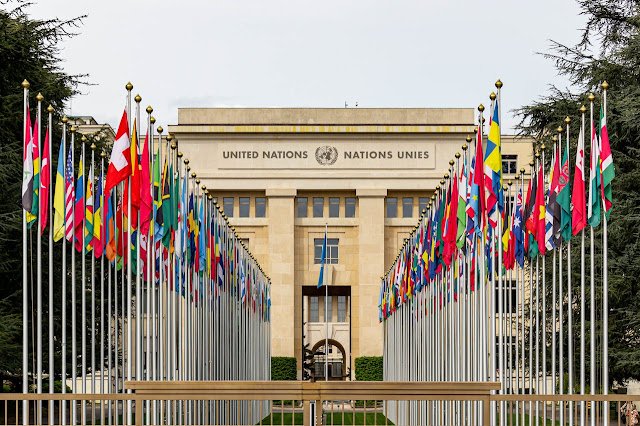

What Future for Multilateralism!
Geopolitics
vs. Global Governance
The multilateral system, centered around the United
Nations (UN), was born from the ashes of World War II, founded on the premise
of collective security and shared responsibility. For
decades, it provided a platform for cooperation on issues ranging from
peacebuilding and human rights to economic development and public health.
existential threat: the resurgence of intense great power rivalry, notably between the United States and China, compounded
by Russia’s aggressive actions and increasing global fragmentation.
for a unipolar or bipolar world, adapt to a new era of strategic competition,
or is the future of global governance
destined to be fractured?
How Rivalry Weakens the UN
The core mechanisms of the UN system are being stretched
and paralyzed by competing national interests, making meaningful collective
action increasingly difficult.
1. The Paralysis of the
Security Council (UNSC)
·
Keyword
Integration: The UN Security Council
is the linchpin of global peace and security, yet it is where geopolitical tensions are most
visible.
·
The
Veto Power: The permanent members
(P5)—the US, UK, France, China, and Russia—wielding the veto power, were
intended to ensure that no collective action would be taken against a major
power. However, in the current climate, this power is routinely used to block
resolutions on critical global issues, such as the conflict in Ukraine or
humanitarian crises in the Middle East and Syria. This impasse undermines
the Council’s credibility and ability to respond effectively to new conflicts,
leaving the world vulnerable.
2. Weaponization of
Institutions and Norms
·
Keyword
Integration: Great power rivalry
is not just about military build-ups; it’s also about a contest for influence,
leading to the weaponization of international
organizations.
·
Contesting
Norms: Powers like China and Russia have
been actively expanding their influence within UN specialized agencies,
sometimes promoting norms that emphasize state sovereignty over individual
human rights.
creating ideological splits. This struggle turns technical and humanitarian
bodies (like WHO or ITU) into arenas for systemic competition,
diverting focus from their core mandates.
3.
The Challenge to Liberal Internationalism
·
The post-war order was largely underpinned by Western liberal
principles.
of global governance, often
prioritizing domestic stability and state-centric development over Western
democratic norms, fundamentally challenges the philosophical basis of
multilateralism. This ideological schism makes building consensus on critical
issues like human rights, trade, and even climate policy significantly harder.
Technology and Economic Fragmentation
Beyond traditional security concerns, the future of multilateralism is being determined
by technological and economic competition.
1.
Fragmentation of the Global Economy
·
Keyword
Integration: Economic decoupling
and trade wars, driven by the US-China rivalry, introduce immense strain on
institutions like the WTO.
·
Techno-Nationalism: The drive for technological supremacy in areas like
Artificial Intelligence (AI) and 5G has led to techno-nationalism,
where states prioritize national technological autonomy over open, shared
standards. The absence of a robust multilateral framework
for regulating these new technologies threatens to create competing, siloed
technological spheres, further undermining global interconnectivity and
cooperation.
2.
Competition in the Global South
·
Both
the US and China are actively vying for influence in the Global South through
development aid, infrastructure projects, and diplomatic engagement within the
UN. While this competition can sometimes lead to increased investment, it often
forces developing nations into difficult choices, fragmenting political blocs
within the UN General Assembly and hindering unified action on shared
challenges like sustainable development
and climate change.
Reimagining Multilateralism to Survive
The UN system is undeniably struggling, but its total
collapse would be catastrophic, leading to a world without essential
coordination mechanisms for global public goods.
Survival hinges on radical adaptation.
1.
Focusing on Collective Action Imperatives
·
Keyword
Integration: The future of international cooperation must focus on challenges that absolutely require global
collective action, regardless of geopolitical tensions.
·
The
Unavoidables: Issues like climate change, global public health (pandemics), nuclear
non-proliferation, and cross-border financial stability cannot be solved
unilaterally.
can provide a vital common ground where rivals can find pragmatic,
self-interested reasons to cooperate.
2.
Reform and Legitimacy
·
Reform
of the UN Security Council is essential to
restore legitimacy. While politically challenging, proposals for expanding
membership (including major powers like India, Germany, Japan, and Brazil) or
restricting the use of the veto in cases of mass atrocities are gaining
traction. A system that better reflects the current multipolar world
would be more legitimate and resilient.
3. The
Rise of “Mini-lateralism” and Coalitions
·
In
areas where the UN is deadlocked, multilateralism is
evolving into “mini-lateralism“—smaller, issue-specific coalitions of
the willing (e.g., G7, G20, or specialized alliances for climate action). While
these formats cannot replace the universal reach of the UN, they can provide a
necessary dynamism, finding solutions that can later be integrated back into
the UN framework when consensus is possible.
A Darwinian Moment for the UN
The UN system is facing a “Darwinian moment,”
where adaptation is a prerequisite for survival. While great power rivalry threatens
to dismantle the consensus-based foundation of the post-war order, the sheer
scale of modern global challenges—from pandemics to environmental
collapse—underscores that multilateralism is
not an option but a necessity. The UN system may not look the same in the
decades to come; it will likely be messier, slower, and more reliant on
flexible coalitions. However, as the indispensable platform for dialogue, its
continued existence—even in a reformed and contested form—remains vital to
preventing the world from fully fragmenting into competing spheres of
influence.
Quality Assurance: At our platform, we combine cutting-edge AI insights with
human expertise. While this article utilized AI tools for initial research,
every recommendation and insight has been manually verified by our experts to
ensure it meets our high standards of quality and helpfulness.

