
achawari.com
For decades, Morocco’s trade compass pointed firmly North. With the European Union accounting for the lion’s share of its outbound goods, the Kingdom’s economic health was inextricably linked to the Mediterranean’s upper rim. However, as we move through 2026, a seismic shift is occurring. The African Continental Free Trade Area (AfCFTA) has moved from a legislative framework to a functional engine of growth, fundamentally altering the trajectory of Moroccan exports.
1. A New Era of South-South Cooperation
Morocco’s “African Choice” is no longer just a diplomatic stance; it is a multi-billion dollar economic reality. Under the leadership of King Mohammed VI, the Kingdom has positioned itself as a bridge between Europe and the rest of the continent.
The AfCFTA, which aims to eliminate tariffs on 97% of goods traded within Africa, is the catalyst Morocco needed to diversify its export portfolio. By reducing the reliance on traditional markets like Spain and France, Moroccan businesses are finding fertile ground in West, Central, and East Africa.
2. Key Sectors Leading the Charge
The impact of the AfCFTA is most visible in Morocco’s “industrial hubs.” In 2026, three specific sectors are spearheading the continental expansion:
A. The Automotive Revolution
Morocco is now the undisputed leader in African car manufacturing. With the AfCFTA reducing cross-border barriers, “Made in Morocco” vehicles are increasingly appearing on the streets of Lagos, Nairobi, and Abidjan. The removal of technical barriers and the harmonization of standards have allowed Moroccan-based OEMs to compete more effectively with Asian and European imports.
B. Agriculture and Agribusiness
Beyond raw produce, Morocco is exporting value-added food products. The Kingdom’s expertise in food processing—from canned fish to olive oil—is meeting the rising demand of the African middle class.
C. Phosphates and Fertilizers (OCP Group)
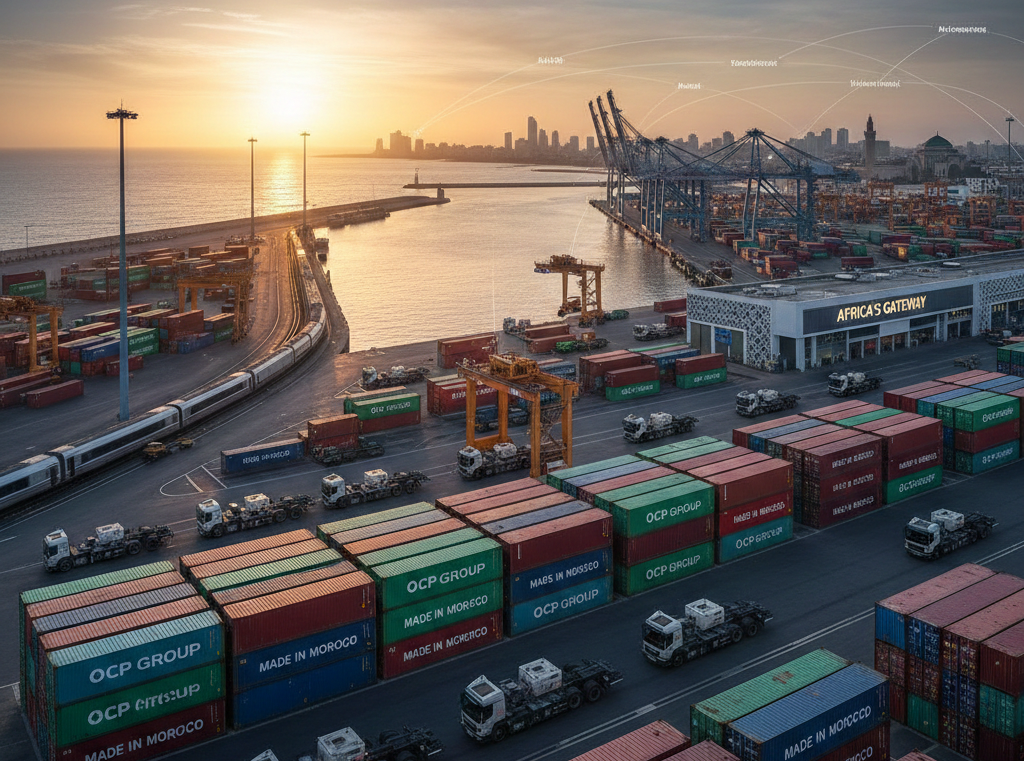
The OCP Group remains a strategic titan. By providing customized soil fertilizers across the continent, Morocco is not just exporting a product; it is exporting food security. The AfCFTA has streamlined the logistics of moving these essential inputs, lowering costs for African farmers and boosting Moroccan revenue.
3. Trade Statistics: The 2026 Outlook
Recent data from the Office des Changes and international trade monitors suggest a positive trend for the Kingdom’s balance of trade.
| Metric | 2024 Performance | 2026 Forecast |
| Intra-African Export Share | ~7% of total | ~12-15% of total |
| Export Growth Rate | 3.3% YoY | 7.9% Projected |
| Primary Export Hubs | Senegal, Ivory Coast, Egypt | Nigeria, Ethiopia, Kenya |
Key Insight: While the EU remains a vital partner, the growth rate of Moroccan exports to AfCFTA member states is outstripping that of any other region.
4. Overcoming Challenges: Logistics and Infrastructure
The path to a fully integrated African market isn’t without hurdles. Moroccan exporters still face “non-tariff barriers” (NTBs) such as complex customs procedures and infrastructure gaps.
However, Morocco’s investments in the Tanger Med Port and the proposed Nigeria-Morocco Gas Pipeline are more than just infrastructure projects—they are the arteries of future trade. These developments are reducing the “time-to-market” for Moroccan goods, making them more competitive in distant African markets.
5. Why the AfCFTA Matters for Moroccan SMEs
Small and Medium Enterprises (SMEs) are the backbone of the Moroccan economy. Previously, the cost of entering African markets was prohibitive for smaller players. In 2026, the AfCFTA’s digital trade protocols and simplified rules of origin are allowing Moroccan startups and small manufacturers to scale across borders with significantly lower overhead.
A Continental Champion
The impact of the AfCFTA on Moroccan exports is transformative. It has turned a regional leader into a continental powerhouse, fostering an environment where innovation and industrialization can thrive. As the 2026 fiscal year progresses, the data is clear: Morocco’s economic future is increasingly African.
