

achawari.com
As the modern world grapples with climate instability and soil depletion, the answers to a sustainable future might just be buried in the past. Specifically, in the arid and diverse landscapes of Morocco, a centuries-old system known as the “Filaha” or the traditional agricultural calendar continues to guide farmers through the harshest seasons. This ancestral wisdom isn’t just a relic of history; it is a blueprint for climate resilience that the global agricultural sector desperately needs.
The Rhythm of the Earth: Understanding the Berber Lunar and Solar Cycles
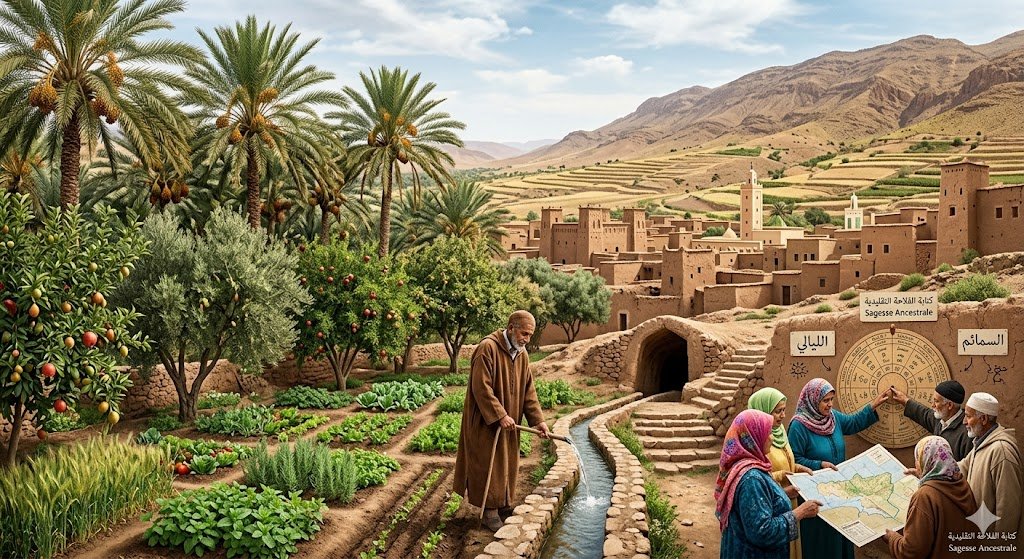
Moroccan traditional farming doesn’t rely solely on modern meteorology. Instead, it follows a sophisticated blend of the Julian calendar and lunar cycles, deeply rooted in Amazigh (Berber) culture. The year is divided into distinct periods, such as the “Liyali” (the 40 coldest days of winter) and the “Smaym” (the 40 hottest days of summer).
By understanding these micro-seasons, Moroccan farmers know precisely when the earth “breathes” and when it “sleeps.” This synchronization allows them to plant and harvest at times that maximize natural yields without the heavy use of synthetic stimulants. For the global community, this teaches a vital lesson: Agriculture is more effective when it adapts to the environment rather than trying to dominate it.
Water Management: The Genius of the Khettara System
One cannot discuss Moroccan agricultural wisdom without mentioning the Khettara. This ancient underground aqueduct system transports water from distant aquifers to dry fields using nothing but gravity.
Unlike modern irrigation that often leads to massive evaporation and salinity, the Khettara keeps water cool and protected. While we look toward high-tech “smart” irrigation, the Moroccan model reminds us that low-tech, gravity-fed, and community-managed systems are often more durable and ecologically sound. It is a masterclass in zero-energy water conservation.
Biodiversity and the “Oasis Effect”
Traditional Moroccan farming thrives on polyculture. In the southern oases, you will find a three-tiered canopy system:
- Top Tier: Date palms providing shade and wind protection.
- Middle Tier: Fruit trees like olives, pomegranates, and almonds.
- Bottom Tier: Forage crops, vegetables, and medicinal herbs.
This “Oasis Effect” creates a self-sustaining microclimate that protects delicate crops from the scorching sun. Modern industrial farming, which favors monoculture (growing only one crop), is highly vulnerable to pests and heatwaves. Adopting the Moroccan multi-layered approach could revolutionize how we design “forest gardens” and sustainable urban farms worldwide.
Soil Preservation: The Art of the Fallow and Natural Fertilization
Before the advent of chemical fertilizers, Moroccan farmers maintained soil health through “Al-Bayer” (leaving land fallow) and the use of organic livestock manure. They understood that soil is a living organism that requires rest to regenerate its nutrients.
In a world where 33% of the earth’s soil is already degraded, returning to these “slow farming” techniques is no longer a choice—it’s a necessity. By integrating livestock with crop rotation, Moroccan wisdom offers a circular economy model that reduces waste and restores the carbon-sequestering potential of the land.
