

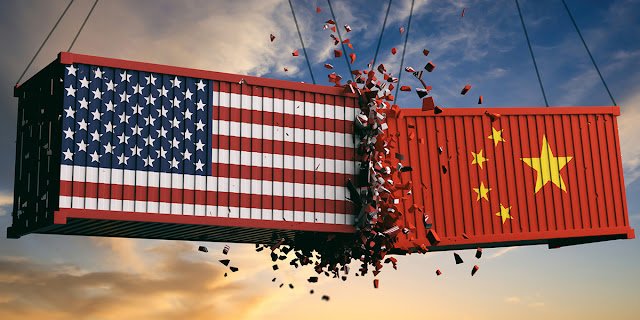

The relationship between the United States and China is the most
consequential of the 21st century. It’s a complex
tapestry of deep economic interdependence woven with threads of intense
strategic rivalry.
As these two global titans vie for influence, the world watches with bated
breath, asking a critical question: Can the U.S. and China avoid conflict? The
specter of a great power confrontation looms large, carrying with it the
potential to reshape the global order, disrupt economies, and impact the lives
of billions.
This
article delves into the heart of U.S.-China geopolitical tensions, exploring
the roots of their rivalry, the dangerous flashpoints that could ignite a
conflict, and the potential pathways toward a more stable, peaceful
coexistence. Understanding this dynamic is not just an academic exercise; it’s
essential for navigating the uncertain terrain of our shared future.
The Roots of Rivalry: A Clash of Ideologies and Interests
The current friction between Washington and Beijing
isn’t a recent phenomenon.
It’s the culmination of decades of differing ideologies, competing economic
models, and divergent strategic ambitions. While they were once cautious
partners, today they are unequivocal competitors.
Economic Competition and the Trade War
For years, the U.S. and China were the engine of globalization. China’s manufacturing prowess, fueled by American investment
and consumer demand, lifted hundreds of millions from poverty.
However, this symbiotic relationship soured as China’s economic might grew. The U.S. began to voice concerns over unfair trade practices,
intellectual property theft, and state-subsidized industries that undercut
American companies.
This
tension erupted into a full-blown U.S.-China trade war, characterized by
tit-for-tat tariffs on billions of dollars worth of goods.
While the rhetoric has cooled at times, the underlying economic friction
remains a primary driver of the rivalry. At stake is not just economic
dominance, but the leadership of the global economic system itself.
Technological Supremacy and the AI Race
The new frontier of competition is technology. The
race for supremacy in areas like artificial intelligence (AI), 5G
telecommunications, quantum computing, and semiconductors is a zero-sum game in
the eyes of many policymakers in both nations.
The U.S. views China’s tech ambitions, particularly initiatives like “Made
in China 2025,” as a direct threat to its long-held technological edge and
national security.
Washington
has responded by placing Chinese tech giants like Huawei on blacklists and
implementing stringent export controls to hobble China’s semiconductor industry.
Beijing, in turn, is pouring massive resources into
achieving technological self-sufficiency.
This “tech war” is decoupling the world’s two
largest economies and creating digital divides that could define the future of
the internet and global innovation.
Military Posturing in the Indo-Pacific
As China’s economic power has grown, so has its military ambition. The People’s Liberation Army (PLA) has undergone a rapid and
impressive modernization, developing advanced naval assets, stealth fighters,
and sophisticated missile systems.
Beijing’s primary focus is the Indo-Pacific,
where it seeks to assert its territorial claims and challenge the U.S.
military’s long-standing dominance.
This
has led to increased military posturing, particularly in the South China Sea,
where China has built and militarized artificial islands despite international
condemnation.
The U.S. responds with “freedom of
navigation” operations, sailing its warships through these contested
waters to assert international law.
Each maneuver, each patrol, carries the risk of miscalculation and escalation.
Flashpoints and Fault Lines: Where Conflict Could Erupt
While broad competition defines the relationship, several specific
flashpoints pose an immediate risk of escalating from tension to open conflict.
These are the geopolitical fault lines where the plates of American and Chinese
power grind against each other most dangerously.
The Taiwan Question: A Red Line for Beijing
No issue is more perilous than Taiwan. The Chinese Communist Party
views the self-governing democratic island as a renegade province and has never
renounced the use of force to achieve “reunification.” For Beijing, Taiwan is a core interest, a “red
line” that cannot be crossed.
The
United States, under its policy of “strategic ambiguity,” does not
officially recognize Taiwan’s independence but maintains robust unofficial
relations and is legally obligated to help the island defend itself.
Increased U.S. political support for Taipei and stepped-up military drills by
the PLA around the island have made the Taiwan Strait the world’s most
dangerous tinderbox. A conflict over Taiwan would be catastrophic,
likely drawing in the U.S., China, and regional allies like Japan and Australia.
South China Sea: Navigational Freedom vs. Territorial Claims
The South China Sea is a critical global waterway
through which trillions of dollars in trade pass annually.
China claims almost the entirety of it, citing historical precedent, and has
built military outposts to enforce its claims. This directly challenges several
of its neighbors—including Vietnam, the Philippines, and Malaysia—and the
principle of freedom of navigation, a cornerstone of U.S. foreign policy. The
risk of a naval or aerial incident between U.S. and Chinese forces in this
congested maritime space is alarmingly high.
Cyber Warfare and Espionage: The Digital Battlefield
Long before any shots are fired, a war is already being waged in the digital
realm. Both nations engage in sophisticated cyber
espionage to steal military secrets, commercial intellectual property, and
sensitive government data.
The potential for a debilitating cyberattack on
critical infrastructure—power grids, financial systems, or communication
networks—is a constant threat.
This shadowy digital conflict lowers the threshold for aggression and
complicates efforts at de-escalation.
Pathways to Peace: Can Conflict Be Averted?
Despite the grim outlook, war is not inevitable. The very factors that drive
competition also create powerful incentives to avoid a full-scale conflict. The
question is whether statesmanship and shared interests can prevail over
nationalism and strategic rivalry.
The Thucydides Trap: A Historical Warning
Harvard professor Graham Allison coined the term
“Thucydides Trap” to describe the tendency toward war when a
rising power threatens to displace an established ruling power.
Historically, this has often ended in conflict. However, recognizing the trap
is the first step to avoiding it. Both U.S. and Chinese leaders are acutely
aware of the history and the catastrophic costs of a great power war in the
nuclear age.
###
Diplomacy and Dialogue: Keeping Lines of Communication Open
The most crucial tool for avoiding conflict is consistent and clear
communication. When tensions are high, it is vital that military and diplomatic
leaders can pick up the phone to de-escalate a crisis. High-level summits and
working groups on issues like climate change, pandemic preparedness, and
financial stability provide opportunities to build guardrails into the
relationship. While deep mistrust persists, U.S.-China diplomacy remains
the most important off-ramp from the path to war.
Economic Interdependence: A Double-Edged Sword
While economic competition is a source of tension, the deep entanglement of
the U.S. and Chinese economies also serves as a powerful deterrent. A war would
sever supply chains, crash global markets, and trigger a worldwide depression.
This concept of “mutually assured economic destruction” means that
both sides have a profound stake in maintaining a degree of stability. However,
as both nations pursue policies of “de-risking” and self-sufficiency,
this economic ballast may become less effective over time.
Conclusion:
Can the U.S. and China avoid conflict? The answer is a cautious and
conditional “yes.” The path forwar Quality Assurance: At our platform, we combine cutting-edge AI insights with human expertise. While this article utilized AI tools for initial research, every recommendation and insight has been manually verified by our experts to ensure it meets our high standards of quality and helpfulness.d is
perilous, fraught with risks of miscalculation and escalation at flashpoints
like Taiwan and the South China Sea.
The rivalry is structural, deep-seated, and unlikely to disappear.
However,
a catastrophic war is not preordained. The future of U.S.-China relations will
be defined by a state of intense, managed competition. Avoiding the Thucydides
Trap will require skillful diplomacy, a clear understanding of each other’s red
lines, and a shared commitment to preventing competition from spiraling into
conflict. The challenge for leaders in Washington and Beijing—and for the world
at large—is to build the guardrails necessary to ensure this 21st-century great
power rivalry does not end in tragedy.
Frequently Asked Questions (FAQ)
# Is a war between the US and China inevitable?
No, war is not inevitable, but the risk is significant. While historical
precedents like the “Thucydides Trap” suggest a high likelihood of
conflict when a rising power challenges a ruling one, both the U.S. and China
have strong incentives to avoid a direct military confrontation, including
economic interdependence and the catastrophic potential of a nuclear conflict.
The outcome will depend on diplomacy, crisis management, and the political will
of both nations.
# What is the biggest risk for a US-China conflict?
The overwhelming consensus is that Taiwan is the most dangerous
flashpoint. China considers the island a core national interest and is prepared
to use force, while the U.S. is committed to helping Taiwan defend itself. A
miscalculation or deliberate escalation in the Taiwan Strait could quickly
spiral into a major war.
# How does the U.S.-China rivalry affect the global economy?
The rivalry creates significant economic uncertainty. The trade war has disrupted supply chains and
increased costs for businesses and consumers.
The “tech war” is leading to a decoupling of
technology ecosystems, forcing other countries to choose sides.
A full-blown conflict would be devastating, likely triggering a global
recession or depression far worse than the 2008 financial crisis.
# What is the “Thucydides Trap”?
The Thucydides Trap is a concept popularized by
political scientist Graham Allison.
It describes the dangerous dynamic that occurs when a rising power (like China)
causes fear in an established power (like the U.S.). The term is named after
the ancient Greek historian Thucydides, who wrote that “it was the rise of
Athens and the fear that this instilled in Sparta that made war
inevitable.” Allison’s research shows that in 12
of 16 similar cases over the past 500 years, the result was war.

