

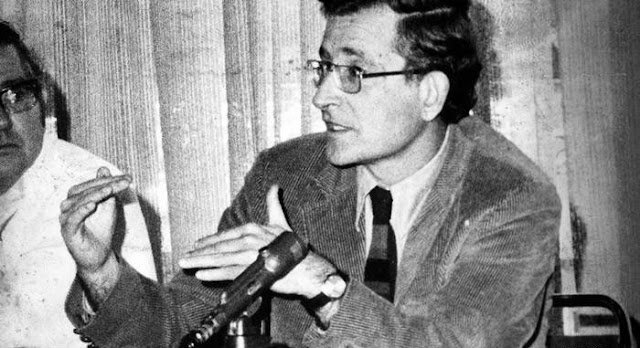

Noam Chomsky
 |
| Noam Chomsky |
By Facebooq.ma
Avram
Noam Chomsky is not merely an academic; he is a seismic force whose
intellectual contributions have profoundly reshaped three distinct yet
interconnected fields: linguistics, political science, and philosophy.
Born on December 7, 1928, in Philadelphia, Chomsky is
an American polymath, often hailed as “the father of modern
linguistics,” whose theories catalyzed the “cognitive
revolution” in human sciences.
But his influence extends far beyond the ivory tower;
since the 1960s, he has been an enduring and fierce public intellectual, a
self-described libertarian socialist, and a relentless critic of U.S.
foreign policy, corporate power, and the mainstream media.
A
testament to his vast influence, Chomsky is one of the most cited scholars in
modern history, having authored over 150 books.
To understand the 21st century’s intellectual landscape, one must first grasp
the portrait of this American original—a man who challenged the fundamental
assumptions of how we acquire language, how societies are governed, and how
truth is communicated.
The Linguistic Revolution: Rewriting the Rules of Language
Chomsky’s early work laid the foundation for his formidable reputation. He emerged onto the academic scene in the mid-1950s with a
radical theory that fundamentally upended the prevailing behaviourist
view of language, most notably championed by B.F. Skinner.
Behaviourists believed language was acquired primarily
through imitation, conditioning, and reinforcement—essentially a learned skill,
like riding a bike.
Chomsky dismantled this view in his seminal 1957 work, Syntactic
Structures.
Generative
and Transformational Grammar
Chomsky introduced the concept of Generative
Grammar, a revolutionary theoretical framework that treats language as a
uniquely human, biologically based cognitive capacity.
His core observation, often referred to as “Plato’s
Problem,” was simple yet profound: children are able to effortlessly
produce and understand a potentially infinite number of novel sentences
despite being exposed to a finite, and often flawed, set of linguistic data
(the “poverty of the stimulus” argument).
How
is this possible? Chomsky posited that the human mind
is not a tabula rasa (blank slate) but is instead born with an innate,
specialized capacity for language, which he termed Universal Grammar (UG).
Understanding
Universal Grammar (UG)
Universal Grammar is the theoretical
foundation of Chomsky’s linguistic theory.
It suggests that all human languages share a set of innate
principles—a sort of blueprint—that constrain the structure of any possible
human language.
·
Principles
and Parameters: UG is often described in terms of principles
(universal rules, e.g., all sentences have a subject, though it may be covert)
and parameters (switches that are set differently for each specific
language, e.g., the position of the verb in a sentence). A child’s task is not to learn language from scratch, but
rather to set the correct “switches” based on the linguistic input
they receive.
This accounts for the incredible speed and uniformity of language acquisition
across different cultures.
·
Competence
vs. Performance: Chomsky drew a crucial distinction
between linguistic competence (the speaker’s subconscious, innate knowledge
of the grammar rules) and linguistic performance (the actual use of
language in concrete situations, which can be affected by memory limitations,
distractions, or errors).
Linguistics, in his view, should primarily focus on modeling competence.
This
intellectual shift initiated the Cognitive Revolution, shifting the
focus of psychological and philosophical study from external behaviour to
internal, mental processes.
His models, particularly the idea of context-free
grammar, also had vast ramifications for early computer science and the
development of programming languages.
Philosophy and the Human Mind: The Nature of Creativity
Chomsky’s work extends into the philosophy of
mind, suggesting that the study of language is a key to understanding the
deeper structure of human nature.
By treating language as a mental organ, Chomsky
contributed to the development of cognitive science as an
interdisciplinary field.
He
has consistently stressed the creative aspect of language use—the
ability to produce and comprehend sentences never before encountered.
For Chomsky, this creativity is a manifestation of human freedom and intrinsic
worth, a crucial link between his academic work and his political philosophy.
His emphasis on innate structures stands in stark contrast to empiricist
philosophies that view all knowledge as derived from experience.
The Unrelenting Dissident: Politics, Power, and Propaganda
While his linguistic theories cemented his academic
legacy, Noam Chomsky achieved global notoriety as a political activist, social
critic, and self-proclaimed libertarian socialist or anarcho-syndicalist.
His political life took off during his fierce
opposition to the Vietnam War, leading to his landmark 1967 essay, “The
Responsibility of Intellectuals.”
Critique
of Power and Foreign Policy
Chomsky’s political analysis is rooted in a
fundamental skepticism toward all forms of concentrated authority, be it state
or corporate.
He argues that the burden of proof lies solely upon
those who exercise authority; if that authority cannot be justified, it must be
dismantled.
·
US
Foreign Policy: He is one of the world’s most
prominent critics of U.S. foreign policy, which he views as
systematically driven by the interests of economic and political elites, often
disguised by humanitarian rhetoric.
He meticulously documents what he sees as a pattern of intervention,
aggression, and support for autocratic regimes that align with American
corporate and geopolitical interests.
·
Anarchism
and Libertarian Socialism: Chomsky’s ideal society is a form of libertarian
socialism, a political philosophy that advocates for the abolition of
unjustified hierarchical structures, including the State and private control
over the means of production.
He champions decentralized democratic control of institutions, arguing that the
desire for free, creative, and meaningful work is part of our innate human
nature.
The
Propaganda Model: Manufacturing Consent
Perhaps his most influential contribution to
political science is the Propaganda Model, articulated in the 1988 book Manufacturing
Consent: The Political Economy of the Mass Media (co-authored with
Edward S. Herman).
This
model proposes that the mass media, while presenting itself as objective,
functions as a powerful, subtle propaganda system for elite interests due to
structural, economic factors.
It identifies five “filters” that shape news content:
1. Ownership:
Media is owned by large corporations, whose profit motive and ideological
outlook influence coverage.
2. Advertising:
Media reliance on advertising revenue means content must not offend advertisers.
3. Sourcing:
Journalists rely heavily on government, corporate, and “expert”
sources, which provides a subsidized stream of information favourable to power.
4. Flak: Organized negative responses (or “flak”)
to critical media reports serve as a deterrent to investigative journalism.
5. Anti-Communism/Fear Ideology: A prevailing ideological
“enemy” (historically Communism, later the “War on Terror”)
is used to marginalize dissent and mobilize public opinion in support of state
policy.
Chomsky argues that this system doesn’t require a conspiracy; rather, it’s a
structural outcome where career progression and success in media depend on
internalizing and reproducing the assumptions that serve dominant power
structures.
A Lasting and Divisive Legacy
Chomsky’s uncompromising intellectual honesty and
his ability to apply a rigorous, systematic approach—developed in
linguistics—to the analysis of social power have made him a figure of immense
moral and intellectual authority for many, particularly on the global Left.
However,
his work is not without controversy.
In linguistics, his theories have evolved significantly (e.g., from
Transformational Grammar to the Minimalist Program) and face ongoing
challenges from various schools of thought, including usage-based
linguistics. In politics, his sharp critiques of U.S. foreign policy and
his provocative moral equivalences have drawn intense fire from
neoconservatives, liberals, and even some on the left.
Regardless
of the debate, Noam Chomsky’s legacy is defined by his insistence on intellectual
responsibility and his profound dedication to decoding the deep
structures—be they linguistic or sociopolitical—that govern our world. He
remains a towering, indispensable figure whose lifelong work urges us to look
beneath the surface structure of language, media, and power to find the
underlying truth.
Frequently Asked Questions (FAQ)
Q1: What is the single most important idea of Noam Chomsky’s linguistics?
The single most important idea is Universal Grammar (UG). It posits that the basic design principles of language are innate
to the human mind, meaning children are born with a pre-wired capacity to
acquire language, which revolutionized the field and helped spark the Cognitive
Revolution.
Q2:
Is there a connection between Chomsky’s politics and his linguistics?
Chomsky maintains that the connection is abstract,
rooted in his view of human nature.
His linguistic theory stresses the unique, unbounded
creativity of the human mind (in language), which aligns with his political
philosophy of libertarian socialism that seeks a social order allowing
individuals the freedom to pursue creative and fulfilling work, free from
arbitrary, authoritarian constraints.
Q3:
What is the main argument of Manufacturing Consent?
The main argument is the Propaganda Model,
which suggests that the mainstream mass media acts as a system that
manufactures public support (“consent”) for the policies of the
elite, primarily through a set of economic and structural filters
(ownership, advertising, sourcing, flak, and fear ideology) that effectively
marginalize dissenting voices and ideas.
Q4:
What is Chomsky’s political ideology?
Chomsky identifies as a libertarian socialist
or anarcho-syndicalist.
This ideology advocates for a non-hierarchical,
stateless society where workers democratically control the means of production,
and all social institutions are governed by voluntary association and
decentralized decision-making.
Conclusion:
Noam Chomsky’s portrait is that of the
quintessential public intellectual: a scholar of unparalleled rigour who
refused to confine his critical lens to the academic realm.
From unlocking the secrets of the human language faculty with Universal
Grammar to exposing the mechanisms of power and propaganda through the Propaganda
Model, he has provided tools for understanding—and challenging—the systems
that shape our reality. His work, spanning linguistics, philosophy, and
political dissent, remains a powerful call for skepticism, intellectual
responsibility, and the relentless pursuit of social justice and human
freedom. In an age saturated with information and complex political narratives,
the voice and methodology of Noam Chomsky are more relevant than ever.
Quality Assurance: At our platform, we combine cutting-edge AI insights with human expertise. While this article utilized AI tools for initial research, every recommendation and insight has been manually verified by our experts to ensure it meets our high standards of quality and helpfulness.

