achawari.com
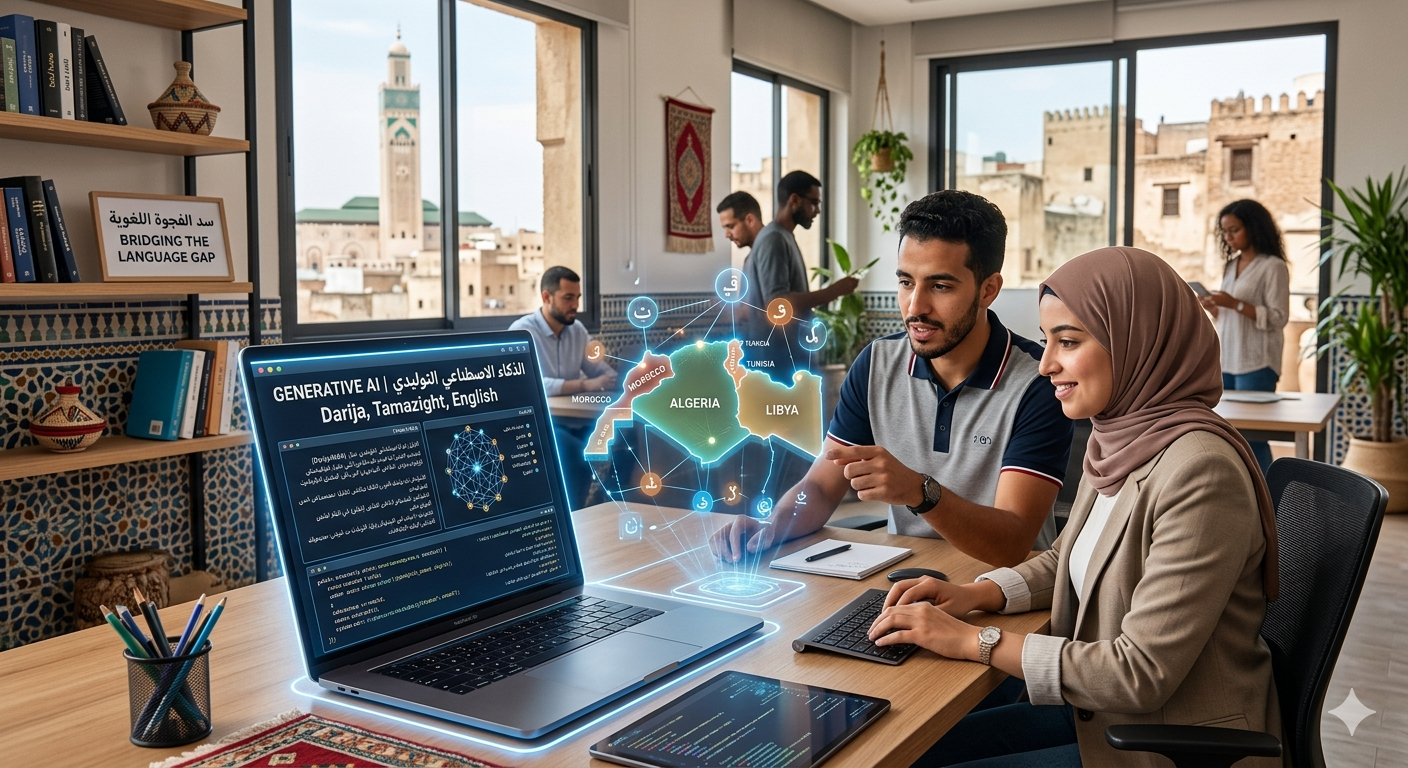
Generative AI in North Africa currently faces a critical “language gap,” as global models prioritize English over local dialects like Darija or Tamazight. However, this deficit presents a multi-billion dollar opportunity for regional developers to build sovereign, culturally-aware AI that drives unprecedented economic and digital inclusion.
Why Global AI Struggles in the Maghreb
While the world marvels at the reasoning capabilities of Large Language Models (LLMs), a silent digital divide is growing across Morocco, Algeria, Tunisia, and Libya. Most dominant AI systems are trained on “High-Resource” languages—primarily English, Chinese, and Spanish.
For a user in Casablanca or Algiers, interacting with an AI often feels like speaking through a filter. The “Language Gap” in North Africa is characterized by three main hurdles:
- Modern Standard Arabic (MSA) vs. Dialects: Most AI models understand formal Arabic (Fusha) but stumble over Darija, which blends Arabic, Berber, French, and Spanish.
- The Underrepresentation of Tamazight: As an official language in Morocco and Algeria, Tamazight (Berber) remains a “low-resource” language in the AI world, lacking the massive text corpora needed for deep learning.
- Code-Switching: North Africans naturally oscillate between languages in a single sentence. Current AI often loses the context of this “Linguistic Couscous,” leading to robotic or inaccurate outputs.
Why 2026 is the Year of North African “Sovereign AI”
The gap isn’t just a challenge; it’s a goldmine. According to recent 2026 economic forecasts, AI could contribute up to $320 billion to the Middle East and North Africa (MENA) economy by 2030. For North Africa specifically, the path to this growth lies in Sovereign AI.
1. Localized E-commerce and Customer Service
Businesses that deploy AI capable of understanding Moroccan Darija or Tunisian Arabic can achieve conversion rates significantly higher than those using generic French or English bots. Localized AI builds trust.
2. Preserving Cultural Heritage
Generative AI offers a unique tool for the “Digital Awakening” of the Tamazight language. By digitizing oral traditions and manuscripts into training sets, North Africa can ensure its heritage isn’t just preserved in museums, but active in the digital future.
3. Agricultural and Healthcare Leapfrogging
In rural areas where literacy in European languages may be lower, voice-activated Generative AI—speaking in local dialects—can provide farmers with weather data or help villagers access preliminary medical advice.
The Rise of “Atlas Chat” and “DarijaBERT”
The region isn’t waiting for Silicon Valley. Local researchers are already making strides:
- DarijaBERT: Specialized models optimized for the nuances of Moroccan Arabic.
- NTeALan Project: An initiative specifically designed to incorporate under-represented African languages into AI frameworks.
- Masakhane: A grassroots organization proving that community-led data collection can outperform corporate “top-down” models.
Note on E-E-A-T: The most successful AI implementations in North Africa are those that combine machine efficiency with human oversight. Local expertise is required to “fine-tune” these models to ensure they respect the social and religious values of the Maghreb.
Conclusion: A Call for Digital Sovereignty
The gap in Generative AI for North African languages is a temporary vacuum waiting to be filled by local innovation. By investing in local datasets and specialized LLMs, the region can move from being a consumer of global tech to a leader in inclusive AI.
