
The Impact of AI on Personal Wealth Management in 2026
The Era of "Intelligent Money"

achawari.com
For decades, professional wealth management was a luxury reserved for the ultra-high-net-worth individual. If you didn’t have millions in investable assets, you were often left with “one-size-fits-all” mutual funds or basic robo-advisors.
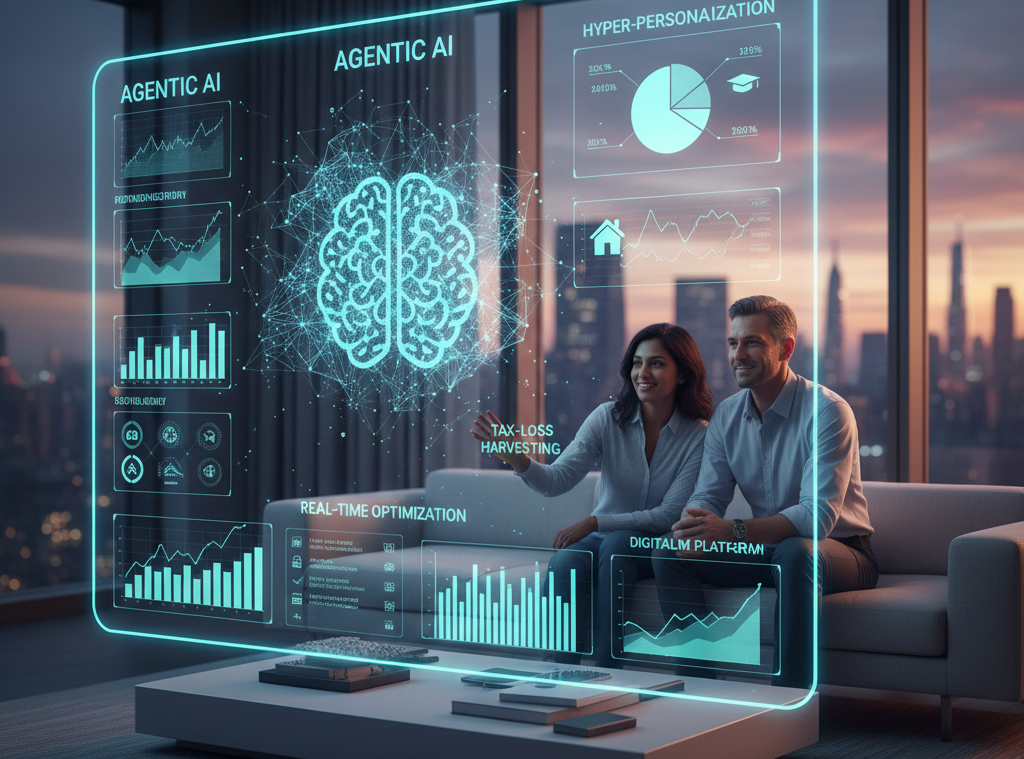
Fast forward to 2026, and the landscape has shifted fundamentally. The rise of Agentic AI and hyper-personalization has democratized elite financial strategies. Today, AI isn’t just a tool in the background; it is a 24/7 financial analyst, a tax-optimization engine, and a strategic partner in building generational wealth.
- From Robo-Advisors to Agentic “Do-Bots”
In the early 2020s, “robo-advisors” were primarily reactive—they rebalanced your portfolio based on a set risk score. In 2026, we have entered the era of Agentic AI.
Unlike their predecessors, these AI “agents” are capable of executing complex, multi-step workflows autonomously. They don’t just tell you that your portfolio is out of whack; they monitor market volatility in real-time and execute Tax-Loss Harvesting strategies the moment a dip occurs, often saving investors thousands in capital gains taxes without a single manual click.
- Hyper-Personalization at Scale
The most significant impact of AI in 2026 is the end of generic financial advice. AI models now create a “unified client brain” by securely analyzing:
- Real-time spending patterns via Open Banking APIs.
- Life milestones (buying a home, planning a wedding, or retiring).
- Psychological risk tolerance based on behavioral data rather than a static 10-question quiz.
This allows for “Personalized Indexing.” Instead of buying a standard S&P 500 ETF, an AI can build a custom portfolio for a retail investor that mirrors the index but excludes companies that conflict with the user’s specific ethical values or local tax situation.
- The Democratization of Private Markets
Traditionally, private equity, venture capital, and private credit were gated communities. In 2026, AI-driven platforms use tokenization to allow fractional ownership of these high-yield assets.
AI algorithms now perform the heavy lifting of due diligence—trawling through thousands of pages of unstructured data to surface “likely-to-succeed” private market opportunities for the mass affluent. This shift has allowed individual investors to achieve the “Alpha” (market-beating returns) previously reserved for institutional hedge funds.
AI vs. Human Advisors: The 2026 Hybrid Model
| Feature | AI Capabilities | Human Advisor Role |
| Portfolio Monitoring | 24/7 real-time tracking | High-level strategic review |
| Tax Optimization | Instant algorithmic execution | Navigating complex legal changes |
| Risk Management | Predictive analytics & stress testing | Emotional support during crashes |
| Goal Setting | Data-backed projections | Defining “The Why” behind wealth |
- The Rise of Predictive Financial Health
In 2026, wealth management has moved from reactive to predictive. AI tools now use “Contextual Intelligence” to provide hands-free coaching.
Imagine your financial app sending a notification: “Your utility bills have increased by 15% over three months. If this trend continues, your 2027 retirement goal will be delayed by four months. Would you like me to find a more competitive energy provider or adjust your discretionary spending?”
This level of proactive management prevents small leaks from sinking the ship of personal wealth.
- Security and the “Black Box” Challenge
With great power comes the need for great oversight. As we move through 2026, Responsible AI has become a competitive advantage. Leading wealth tech firms now prioritize:
- Explainable AI (XAI): Ensuring that an algorithm can explain why it recommended a specific trade.
- Fraud Detection: AI systems now monitor transactions for deepfake-led phishing and identity theft in real-time.
- Regulatory Compliance: Automated “compliance-by-design” ensures that every AI-led decision stays within the bounds of the latest financial regulations.
The Verdict: A Future of Augmented Wealth
The verdict for 2026 is clear: AI has not replaced the human need for financial security; it has simply supercharged our ability to achieve it. While the AI handles the “what” and the “when” of wealth management, the individual—often supported by a human advisor—is finally free to focus on the “why.”
Building wealth is no longer a full-time job of monitoring charts; it’s about setting a vision and letting the algorithms bridge the gap.
