
The Role of AI in Modern Economic Forecasting: Trends and Risks

achawari.com
The global economy in 2026 stands at a pivotal crossroads. What was once dismissed as “tech hype” has matured into the backbone of global financial planning. Artificial Intelligence (AI) is no longer just an experimental tool; it is the primary engine driving modern economic forecasting. From central banks to multinational corporations, the shift from static, linear models to dynamic, self-learning algorithms is reshaping how we predict growth, inflation, and market volatility.
- The Shift from Traditional to AI-Driven Models
For decades, economic forecasting relied on econometric models like ARIMA (AutoRegressive Integrated Moving Average) and linear regressions. While effective in stable environments, these models often struggled with “black swan” events or non-linear market shifts.
In 2026, the landscape is dominated by Machine Learning (ML) and Deep Learning architectures. These systems excel at:
- Alternative Data Processing: Analyzing millions of data points simultaneously, including satellite imagery of shipping lanes, real-time credit card transactions, and sentiment analysis of social media.
- High-Frequency Dashboards: Moving away from quarterly reports to “real-time national accounts” that track productivity and labor shifts by the hour.
- Non-Linear Pattern Recognition: Identifying subtle correlations between geopolitical tensions and commodity price fluctuations that traditional models miss.
- Key Trends Shaping 2026
The current year has introduced several definitive trends that highlight the “Great Divergence” between AI-integrated economies and those lagging behind.
The Productivity Surge
According to recent projections from the IMF and major financial institutions, AI investment is acting as a significant “shock absorber” against global headwinds. In the United States, AI-driven capital expenditure is expected to support a GDP growth of approximately 2.25% to 2.4% in 2026, effectively offsetting the drag from trade tariffs and aging demographics.
The “Silver Economy” and Workforce Retention
A fascinating trend in 2026 is the use of Specialized AI Agents to preserve domain expertise. As the “New Silver Economy” emerges, AI is being used to augment senior employees, allowing them to remain productive longer by automating the manual components of their roles while leveraging their deep institutional knowledge.
Embedded Intelligence in Supply Chains
AI is now deeply embedded in supply chain forecasting. By using Digital Twins, companies can simulate thousands of “what-if” scenarios—from port strikes to sudden energy price hikes—allowing for more resilient budgeting and inventory management.
- The Risks: Navigating the “AI Reckoning”
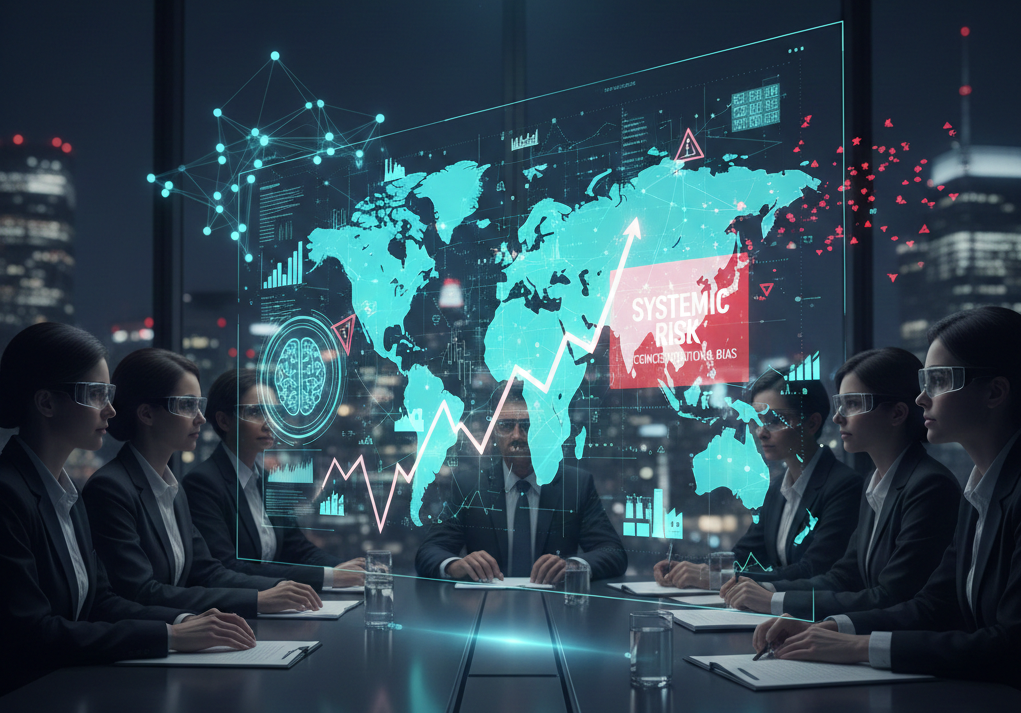
Despite the efficiency gains, 2026 is also being called the year of “AI Reckoning.” The integration of AI into the core of economic forecasting brings unique systemic risks.
The Concentration Risk
A primary concern for 2026 is the extreme concentration of market performance. With a handful of “Mega-Cap” tech firms driving the majority of S&P 500 growth, any earnings miss or cooling of “AI exuberance” could trigger a broad market correction. Analysts warn of a 25%–30% chance of a scenario where AI fails to deliver the expected productivity dividends, leading to significant valuation shifts.
The “Black Box” Problem and Model Bias
Transparency remains a major hurdle. Many AI models operate as “black boxes,” providing accurate results without explaining the why. For policymakers, this lack of interpretability is dangerous. Furthermore, if historical data used to train these models contains biases—such as past discriminatory lending practices—the AI may inadvertently amplify these inequalities in its future projections.
Energy and Infrastructure Constraints
The physical side of AI—data centers and advanced chips—is placing unprecedented demand on global power grids. Geopolitical tensions over access to the “AI stack” (energy, silicon, and data) are creating a new layer of volatility that economic models must now account for.
- AdSense Compliance and Content Integrity
As AI-generated content becomes more prevalent (the so-called “AI slop”), there is a premium on high-quality, human-curated analysis. For publishers seeking Google AdSense revenue, maintaining rigorous standards is essential:
- Fact-Checking: Always verify AI-predicted GDP figures against official sources like the IMF or Federal Reserve.
- Transparency: Disclose the use of AI tools in data gathering or content creation to build reader trust.
- Value-Add: Ensure the article provides unique insights beyond basic definitions, adhering to Google’s E-E-A-T (Experience, Expertise, Authoritativeness, and Trustworthiness) guidelines.
Conclusion
In 2026, AI is the definitive lens through which we view the economic future. While it offers unparalleled precision and the potential to unlock a new era of productivity, the risks of market concentration and model opacity cannot be ignored. The most successful organizations this year will be those that balance AI’s predictive power with human-led ethical oversight.
