

Achawari.com
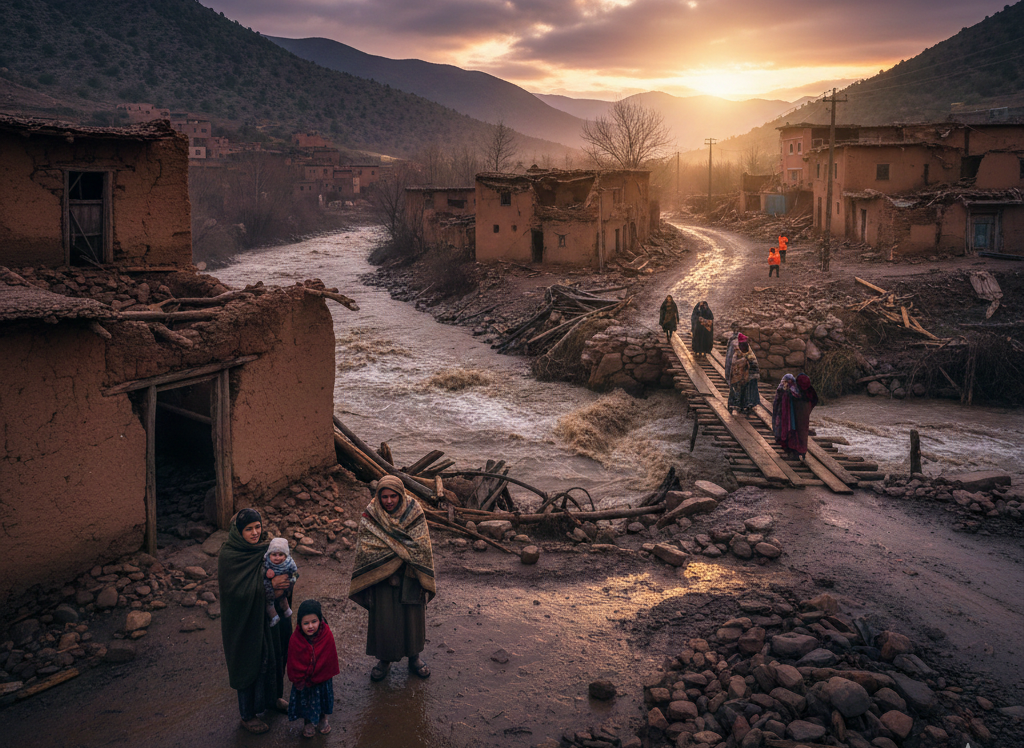
Following the devastating floods that swept through northern and western Morocco, the government has officially classified several territorial communes as “Disaster Zones.” This administrative designation triggers Law No. 110.14, establishing a dual-mechanism system for covering the consequences of catastrophic events through a mix of private insurance and public solidarity.
- What Defines a “Catastrophic Event” Under Moroccan Law?
According to the 2016 legal framework, compensation is only accessible after a formal administrative decision is published in the Official Gazette. A “Catastrophic Event” must meet three criteria:
- The damage must be directly caused by an extraordinary natural factor (e.g., floods).
- The event must be sudden or unavoidable despite standard precautions.
- The consequences must pose a severe threat to the general public.
Key Timeline: The administrative decision identifying disaster zones and the duration of the event must be issued within a maximum of three months from the date of the occurrence.
- Details of the 2026 Emergency Support Program
Under Royal Directives, the government has deployed a comprehensive aid package to support affected households. The aid is structured as follows:
- Direct Financial Aid for Households
- Amount: 6,000 MAD per affected family as immediate relief.
- How to Apply: Heads of households must send an SMS to 1212 containing their National ID (CNIE) number and date of birth to verify eligibility.
- Housing and Commercial Reconstruction Support
| Damage Category | Compensation Amount |
| Completely Destroyed Homes | 140,000 MAD |
| Partial Structural Damage | 15,000 MAD |
| Small Commercial Shops | 15,000 MAD |
- Agricultural Recovery
- Launching a spring crop program (legumes, oilseeds, and fodder) tailored to the affected regions.
- Subsidizing seeds and fertilizers to accelerate the recovery of the agricultural season.
- Providing ongoing support for livestock farmers who lost animals or feed.
III. The Dual Protection System: Insurance & Solidarity
Morocco’s unique system ensures that every citizen is covered, regardless of their insurance status:
- The Insurance Pillar (For the Insured)
Any individual with an existing insurance policy (auto, home, or civil liability) is automatically covered against “Catastrophic Events” by law. In these cases, private insurance companies handle the claims and payouts based on regulated ceilings.
- The Solidarity Pillar (For the Uninsured)
This targets vulnerable populations without insurance. Compensation is managed by the “Solidarity Fund Against Catastrophic Events” (FSEC) and covers:
- Physical Injury: Compensation for permanent disability, death, or loss of a family provider.
- Loss of Primary Residence: Aid for reconstruction or repairs, plus a “loss of use” allowance (equivalent to 3 to 6 months of rental value).
- Procedures for Claiming Compensation
To ensure transparency and fairness, the government has established a strict process:
- Victim Registration: A registry is opened for 90 days following the declaration of a disaster zone.
- Field Surveys: Local specialized committees conduct on-site inspections to assess damage accurately.
- Appeals: Individuals not included in initial lists can submit petitions to local committees for review.
- Dispute Resolution: Before heading to administrative courts, disputes regarding compensation value must be submitted to a “Dispute Resolution Commission.”
- Civil Society Concerns: The “Forgotten Zones”
Despite the government’s response, the “Green Youth” (Jeunesse Verte) movement and other NGOs have criticized the criteria for designating disaster zones.
- Chefchaouen and Al Hoceima: These regions suffered significant road collapses, home damage, and isolation due to heavy snow and rain, yet were initially excluded from the official disaster zone list.
- The Demand: Activists are calling for the immediate correction of these exclusions to ensure that aid reaches all victims without administrative bias.
Summary
Law 110.14 represents a significant shift in Morocco’s disaster management—moving from “seasonal charity” to a “legal right.” Staying informed about the 1212 SMS procedure and the 90-day registration window is crucial for victims to reclaim their livelihoods.
