

achawari.com
Have you ever wondered why your heart races when a certain person walks into the room, or why you feel an instant “spark” with a stranger while others leave you cold? For centuries, poets and artists have called it magic. However, modern neurobiology and psychology suggest it’s actually a sophisticated cocktail of genetics, chemistry, and timing.
Understanding the science of attraction doesn’t take the romance out of the experience; rather, it reveals the incredible complexity of the human mind and body.
- The Genetic Blueprint: MHC and Pheromones
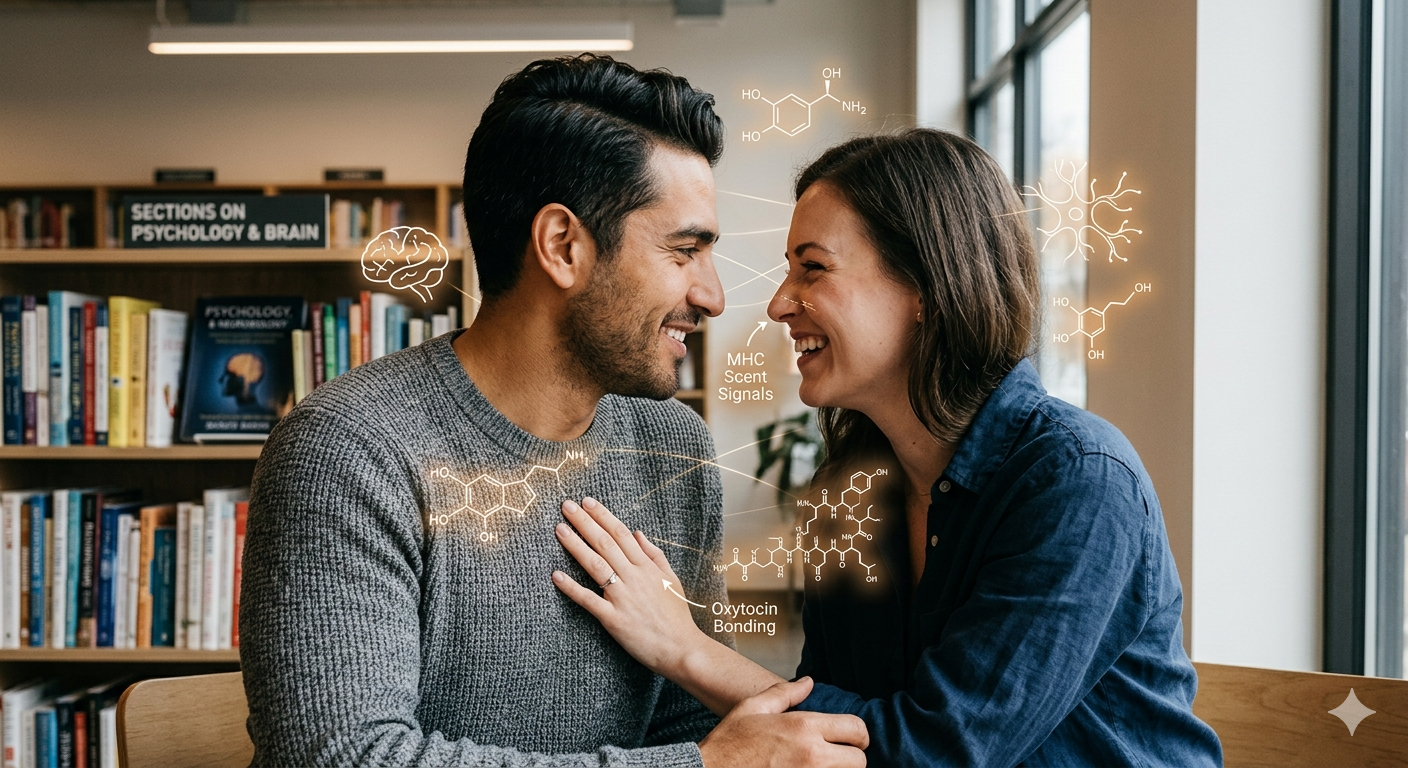
Attraction often begins before a single word is spoken. Research suggests that we are subconsciously drawn to the scent of partners whose immune system genes—specifically the Major Histocompatibility Complex (MHC)—are different from our own.
Evolutionarily, this serves a vital purpose: offspring with diverse MHC genes have stronger immune systems. While humans don’t have a confirmed “pheromone” in the same way insects do, our sense of smell plays a silent, powerful role in “sniffing out” a compatible biological match.
- The Brain on Love: A Chemical Cocktail
When we move from initial attraction to “falling in love,” the brain’s reward system kicks into high gear. Neuroscientists have identified three distinct stages of romantic love, each driven by different chemicals:
- Lust: Driven by testosterone and estrogen.
- Attraction (The “Honeymoon” Phase): This is fueled by Dopamine, the brain’s feel-good neurotransmitter, and Norepinephrine, which causes the sweaty palms and racing heart. During this phase, levels of Serotonin actually drop—which explains why new lovers often become “obsessed” or fixated on their partner.
- Attachment: As the initial frenzy fades, Oxytocin (the “cuddle hormone”) and Vasopressin take over. These chemicals promote long-term bonding, trust, and security.
- The Psychology of “Types”
While biology handles the hardware, psychology handles the software. Why are you attracted to a “type”?
- Proximity: The “Mere Exposure Effect” suggests we are more likely to develop an attraction to people we see frequently. Familiarity breeds comfort, and comfort breeds attraction.
- Similarity: Despite the old adage that “opposites attract,” social psychology consistently finds that we are drawn to people with similar values, backgrounds, and levels of physical attractiveness.
- Attachment Theory: Our early childhood relationships with caregivers often dictate our romantic blueprint. Those with “secure” attachment styles look for stability, while “anxious” or “avoidant” individuals may subconsciously seek out partners who mirror their childhood dynamics.
- The Role of Physical Symmetry
From a biological standpoint, beauty isn’t entirely subjective. Across various cultures, bilateral symmetry (how closely the left side of the face matches the right) is a universal marker of attractiveness.
In nature, symmetry is a visual shorthand for “good health” and “genetic robustness.” When we see a symmetrical face, our brains interpret it as a sign of strong developmental health, making that person more attractive to us on a primal level.
- Why Does Love Fade?
The intense, dopamine-heavy stage of attraction typically lasts between six months and two years. This is a biological necessity; the human body cannot sustain a permanent state of high-stress infatuation. As the “fire” of dopamine cools, the “warmth” of oxytocin must take its place to transition a romance into a partnership.
Conclusion
Falling in love is a multi-sensory, full-body experience that coordinates our hormones, our history, and our DNA. While the science explains the how, the who remains one of life’s most beautiful mysteries.
