Five Reasons Why Morocco is the Digital Gateway to Africa in 2026

Achawari.com
As we move through 2026, the global digital landscape is witnessing a seismic shift toward the “Atlantic Corridor.” At the heart of this transformation lies Morocco. No longer just a tourism powerhouse or an agricultural leader, the Kingdom has successfully rebranded itself as the premier digital gateway to Africa.
For investors, tech giants, and researchers, Morocco offers a unique proposition: a stable, high-tech bridge connecting the trillion-dollar markets of Europe with the exploding digital economy of the African continent.
Here are the five strategic reasons why Morocco has secured its position as Africa’s digital epicenter in 2026.
- The Rise of “Tech Valleys”: Casablanca and Tangier as Innovation Hubs
In 2026, Morocco’s urban centers have evolved into specialized technological ecosystems. The synergy between the economic capital and the northern gateway has created a “dual-engine” for growth.
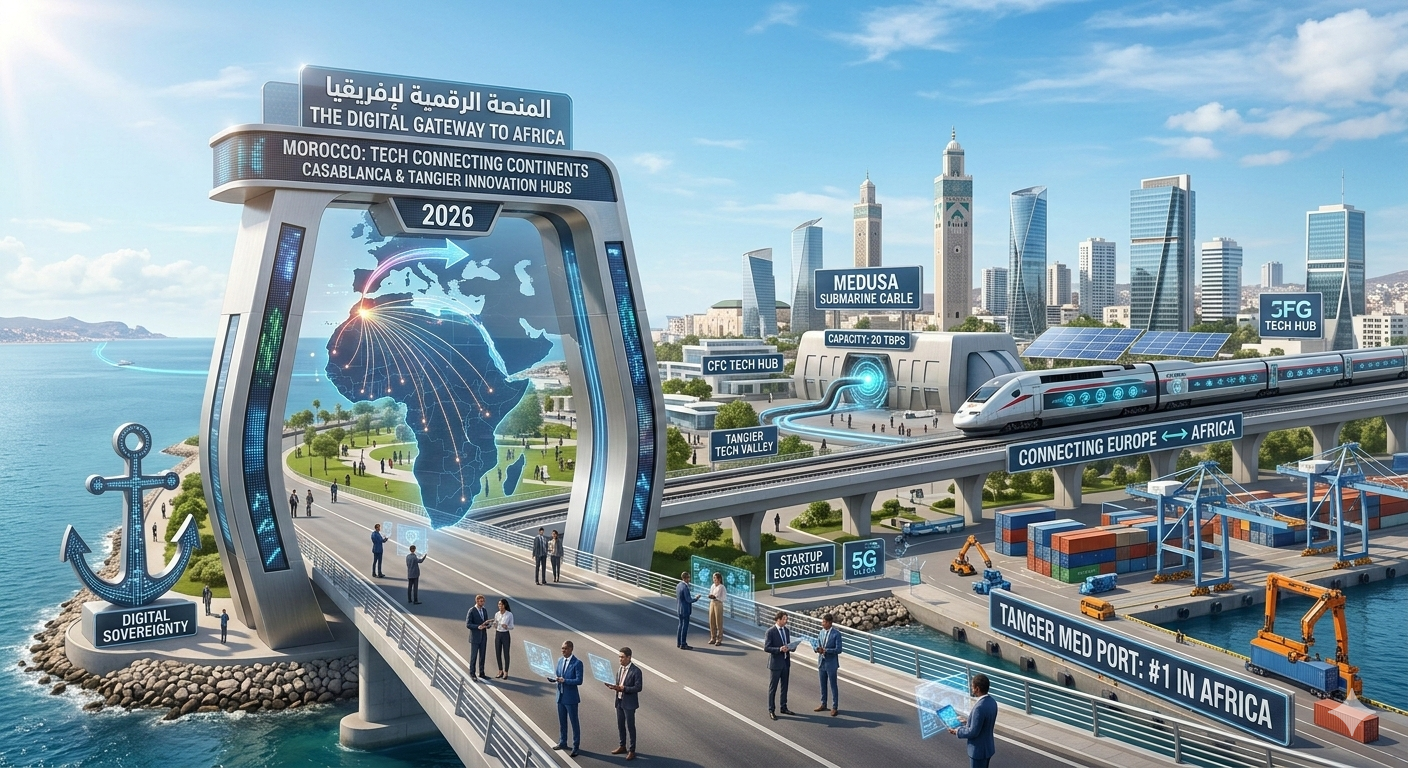
- Casablanca Finance City (CFC) & Tech Valley: Casablanca has moved beyond traditional banking. With the inauguration of the Casablanca Tech Valley in Sidi Othman, the city now hosts over 200 international tech firms. It serves as a regional headquarters for multinational giants looking to manage their African operations from a sophisticated, AI-ready environment.
- Tangier Tech Valley (Mohammed VI Tangier Tech City): Often referred to as Africa’s “Silicon Peninsula,” this project—developed in partnership with global industrial leaders—has become the benchmark for China-Africa and Europe-Africa industrial cooperation. It focuses on smart manufacturing, green tech, and digital logistics, leveraging its proximity to the Tanger Med Port.
- Unrivaled Subsea Connectivity: The Medusa Project and Beyond
Connectivity is the lifeblood of the digital economy. By 2026, Morocco has achieved a level of digital sovereignty that is unmatched in the region.
The Medusa Submarine Cable, which became fully operational in early 2026, connects Nador to Marseille and Barcelona, offering high-speed, low-latency data transmission. With a capacity of 20 Tbps, this infrastructure ensures that data flowing between Europe and Africa travels through Moroccan soil. This makes the Kingdom the most reliable landing point for cloud service providers (CSPs) and global data center operators.
- The “Bridge” Strategy: Connecting Two Continents
Morocco’s geography is its greatest digital asset. In 2026, the Kingdom isn’t just a destination; it’s a transit hub.
- Europe-Africa Integration: Located only 14 kilometers from Europe, Morocco acts as the “Neutral Zone” for data. European firms can comply with GDPR while accessing African markets, and African startups can scale into Europe using Morocco as their legal and technical launchpad.
- Logistics Digitization: The integration of the Tanger Med port (the #1 container port in Africa and the Mediterranean) with blockchain and AI-driven logistics has created a seamless digital supply chain.
- A 2026 Regulatory Framework Built for Investors
The Moroccan government has overhauled its investment charter to meet the demands of the 2026 digital age. New incentives have made the Kingdom a “Safe Landing” for foreign capital:
| Feature | Investor Benefit |
| Tax Holidays | 0% Corporate Tax for the first 5 years in Industrial Acceleration Zones. |
| Repatriation Rights | Guaranteed right to transfer dividends and capital in foreign currency. |
| Digital Morocco 2030 | Direct state subsidies for R&D and AI-driven startups. |
| Exchange Regulations | New 2026 IGOC rules facilitate easier foreign holding structures for tech founders. |
- The Talent Goldmine: A Multilingual, Tech-Savvy Workforce
While other regions face aging populations, Morocco is riding a “youth dividend.” The Kingdom produces over 180,000 graduates annually, with a significant focus on STEM (Science, Technology, Engineering, and Mathematics).
In 2026, Morocco’s workforce is uniquely positioned because of its linguistic versatility. Developers in Casablanca and Tangier are often trilingual (Arabic, French, and English), allowing them to bridge the gap between Middle Eastern investors, European partners, and the global English-speaking tech market.
Conclusion: The Future is “Made in Morocco”
As we look at the digital map of 2026, Morocco stands out as the most stable, connected, and pro-business entry point into Africa. Whether it is through the subsea cables of Nador, the data centers of Casablanca, or the smart factories of Tangier, the Kingdom is no longer just watching the digital revolution—it is leading it.
