
The Great Fragmentation: The Rise of Parallel Economic Systems

Achawari.com
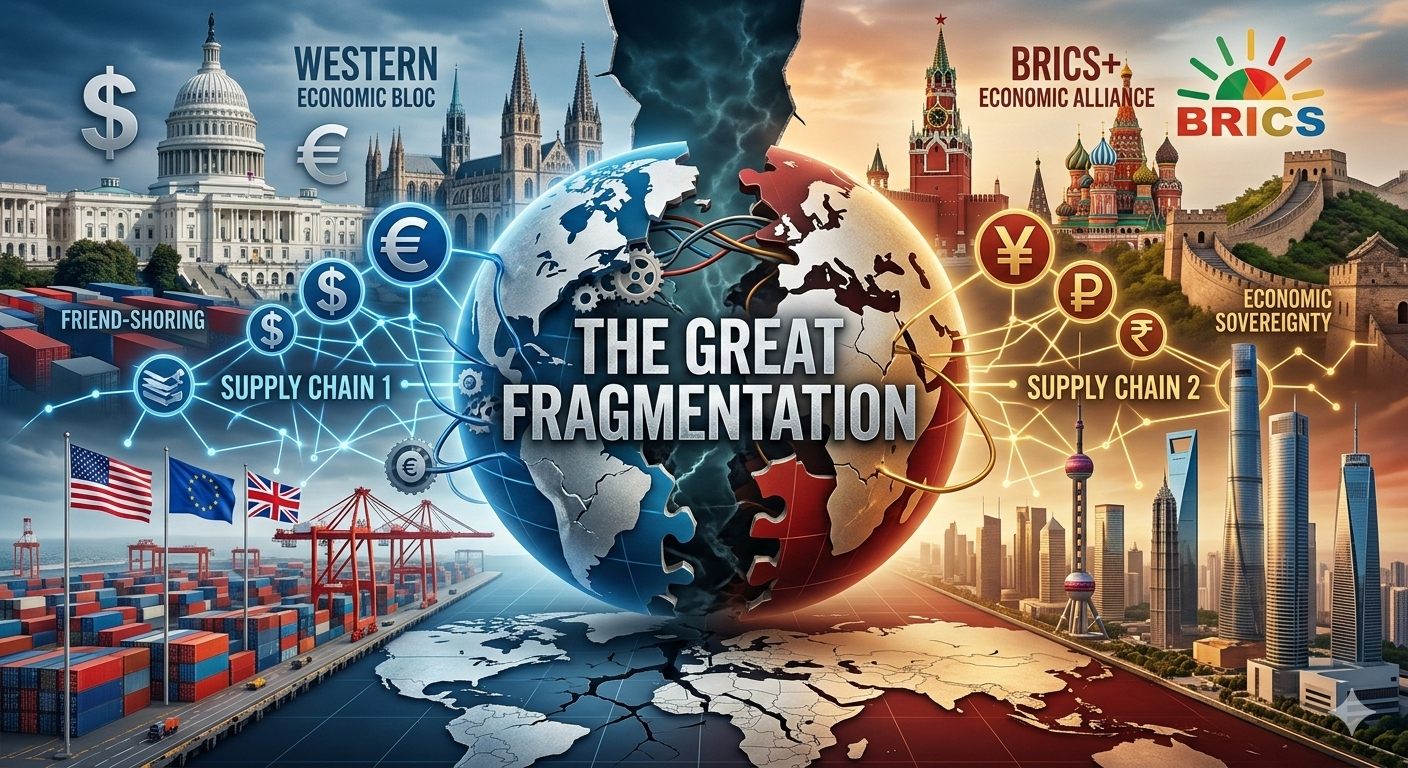
For decades, the world operated under a single, dominant blueprint: hyper-globalization. The goal was simple—efficiency at all costs. However, the dawn of 2026 has solidified a new era. We are witnessing The Great Fragmentation, a structural shift where the unified global market is splitting into distinct, often competing, economic blocs.
This isn’t just a temporary trade spat; it is the birth of parallel economic systems.
The End of the Unipolar Economic Order
The traditional globalized model, led largely by the United States and G7 nations, relied on open markets and the US Dollar as the universal lubricant for trade. This “Washington Consensus” is now being challenged by a “Multipolar Reality.”
The fragmentation is characterized by two primary poles:
- The Western Bloc: Led by the US and EU, focusing on “de-risking” and “friend-shoring.”
- The BRICS+ Bloc: Led by China, Russia, and India, expanding to include major energy players like Saudi Arabia and the UAE, focusing on “economic sovereignty” and alternative payment systems.
The Drivers of Fragmentation
Several catalysts have accelerated this divorce from traditional globalization:
- Geopolitical Weaponization of Finance: The freezing of central bank reserves and the use of SWIFT as a sanction tool have prompted non-Western nations to develop independent financial architectures.
- The Resilience Paradox: The COVID-19 pandemic and the Ukraine conflict proved that “just-in-time” supply chains were fragile. Nations now prioritize security over price, leading to the rise of regionalized trade.
- Technological Sovereignty: From semiconductors to AI, technology is no longer a shared global resource but a guarded national security asset.
Parallel Supply Chains: The New Logistics Reality
As these blocs harden, global supply chains are undergoing a radical transformation. We are moving away from a single global pipeline toward duplicated infrastructure.
1. “Friend-Shoring” and Regionalization
Western companies are increasingly moving manufacturing out of China and into “friendly” nations like Mexico, Vietnam, or Poland. This ensures that even if geopolitical tensions rise, the flow of goods remains steady.
2. The Duel of Standards
We are seeing the emergence of different technical standards. One bloc may adopt Western-led AI ethics and data privacy laws, while the other adopts a Chinese-led infrastructure for 6G and digital currency. Businesses operating in both spheres now face the “dual-stack” challenge—having to build two different versions of the same product to comply with conflicting regulations.
3. Energy and Commodity Re-routing
The Great Fragmentation has fundamentally changed how energy moves. Russian gas that once flowed West now flows East, while Middle Eastern oil is increasingly settled in currencies other than the USD, such as the Yuan or Dirham.
Economic Implications: Inflation and Innovation
While the old version of globalization lowered prices for consumers, The Great Fragmentation comes with a “fragmentation tax.”
- Higher Structural Inflation: Duplicating supply chains and moving factories to higher-cost “friendly” locations is inherently more expensive.
- Reduced Collaboration: Scientific and technological progress may slow down as researchers are restricted from sharing data across bloc lines.
- Market Volatility: Investors must now account for “geopolitical risk” as a primary factor in asset valuation, rather than just corporate earnings.
Navigating the Bipolar Economy
For businesses and investors, the strategy for 2026 and beyond is diversification and adaptability. Relying on a single source—whether for raw materials or customer bases—is now considered a high-risk gamble.
The Great Fragmentation doesn’t mean the end of trade; it means the end of seamless trade. The future belongs to the “bridge-builders”—nations and companies that can navigate the friction between these parallel systems without being forced to choose a side.
Summary Table: Globalization vs. Fragmentation
| Feature | Era of Globalization (1990-2020) | Era of Fragmentation (2024-Present) |
| Primary Goal | Cost Efficiency | Supply Chain Security |
| Currency | USD Dominance | Multi-currency / Digital Assets |
| Trade Policy | Free Trade Agreements | “Friend-shoring” & Sanctions |
| Tech Focus | Global Integration | Technological Sovereignty |
