
A Beginner’s Guide to Understanding Artificial Intelligence: All You Need to Know

Achawari.com
Artificial Intelligence (AI) is no longer a concept confined to the pages of science fiction novels. From the personalized recommendations on your Netflix feed to the voice assistants living in your pocket, AI has become the invisible engine driving the modern world.
But what exactly is it? If you feel like you’re falling behind the curve, don’t worry. This guide breaks down the complexities of AI into simple, digestible concepts.
What is Artificial Intelligence?
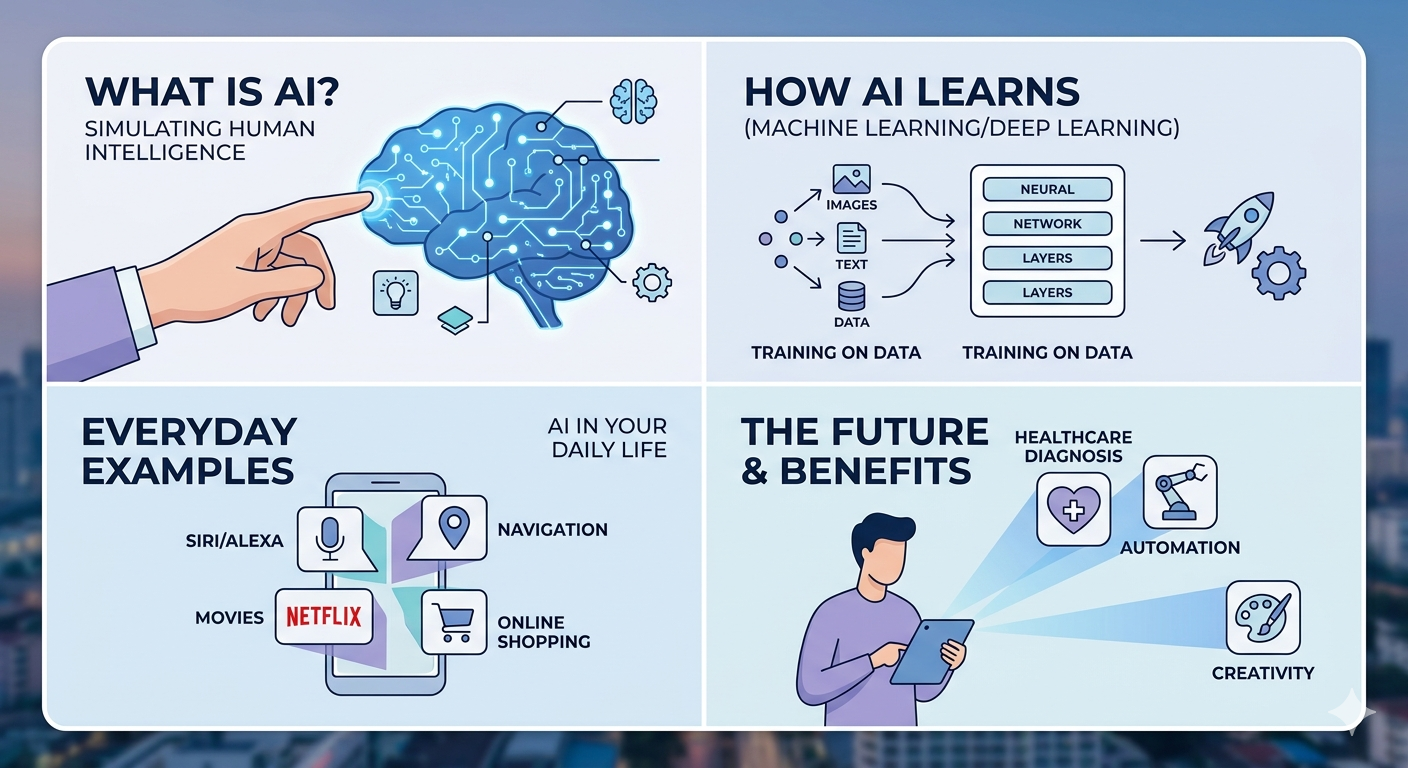
At its core, Artificial Intelligence refers to the simulation of human intelligence by machines, especially computer systems. While a standard computer program follows a strict set of “if-then” rules, an AI system is designed to learn, reason, and solve problems in a way that mimics cognitive functions.
Think of it this way:
- Traditional Software: A digital calculator that does exactly what you tell it.
- Artificial Intelligence: A digital assistant that learns your habits and suggests a faster route to work before you even ask.
The Three Main Pillars of AI
To understand how AI “thinks,” it is helpful to look at the three sub-fields that dominate the industry today:
1. Machine Learning (ML)
Machine Learning is the practice of using algorithms to parse data, learn from it, and then make a determination or prediction about something in the world. Instead of hand-coding software with specific instructions, the machine is “trained” using large amounts of data.
2. Deep Learning
A subset of ML, Deep Learning uses Neural Networks—layered structures inspired by the human brain. This is what allows AI to perform complex tasks like facial recognition or translating languages in real-time.
3. Generative AI
This is the newest “celebrity” in the AI world (think ChatGPT or Midjourney). Generative AI doesn’t just analyze data; it uses what it has learned to create new content, including text, images, and even music.
How Does AI Actually Work?
The process generally follows a three-step cycle:
- Data Input: AI requires massive amounts of data to function. This could be text, photos, or sensor readings.
- Processing (The Algorithm): The AI looks for patterns within that data. For example, by looking at millions of photos of cats, it learns that “pointed ears + whiskers = cat.”
- Output: The system provides an answer, a prediction, or a piece of content based on those patterns.
Real-World Applications of AI
You are likely using AI dozens of times a day without realizing it. Here are some common examples:
- Virtual Assistants: Siri, Alexa, and Google Assistant use Natural Language Processing (NLP) to understand your voice.
- E-commerce: Amazon and Shopify use AI to predict what you might want to buy next based on your browsing history.
- Healthcare: AI algorithms are now being used to spot patterns in X-rays and MRIs that might be invisible to the human eye, leading to earlier diagnoses.
- Transportation: Self-driving features and traffic-prediction apps like Google Maps rely heavily on real-time AI data processing.
Common Myths vs. Reality
- Myth: AI is going to take all our jobs tomorrow.
- Reality: While AI will automate certain tasks, it is primarily a tool for augmentation. It handles the repetitive work, allowing humans to focus on creativity and complex strategy.
- Myth: AI “thinks” just like a human.
- Reality: AI is excellent at pattern recognition but lacks true consciousness, emotional intelligence, and “common sense” intuition.
The Ethics of AI
As AI becomes more powerful, we must address important questions regarding bias and privacy. Because AI learns from human data, it can accidentally pick up human prejudices. Ensuring that AI is developed ethically and transparently is one of the greatest challenges of the 21st century.
Final Thoughts
Artificial Intelligence is a tool—perhaps the most powerful one humanity has ever created. Understanding its basics isn’t just for software engineers; it’s for anyone who wants to navigate the future effectively.
