

By Ahmed Jalali
We were
university students when the Moroccan Green March holiday arrived. I didn’t
like the idea of my friend, the American orientalist Erik, staying alone in the
empty university residence — a place ruled by silence, despair, and stray cats
whenever students left for holidays.
So I invited him
to accompany me to the countryside as a guest of my family in my native
village, Awlad Jalal. He didn’t hesitate. His eyes sparkled with excitement at
the thought of discovering another side of Morocco, where he had come to study
Arabic for six months.
We boarded the
train under cold, heavy rain — “raining cats and dogs,” as the English saying
goes. I wore my modest winter clothes, while he appeared in his well-equipped
American rain gear.
We arrived in
Kenitra before sunset, then took a taxi to Sidi Allal Tazi village. It was
already dark and still raining heavily when we reached my family’s home.
At that time,
there were no phones, no WhatsApp, and none of those modern marvels that have
since captured people’s hearts and eyes. As we stepped through the gate, our
old dog, Dogol, greeted us with a bark that mixed welcome and suspicion — for
he could smell the scent of a foreigner.
 |
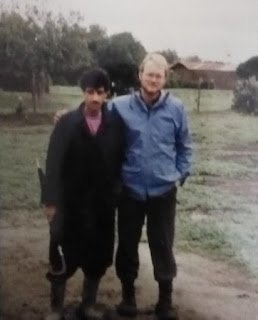
| Ahmed (left) with Erik,1994 |
Before entering,
Erik asked me how he should greet my father, may God rest his soul.
“Just do as I
do,” I told him.
I kissed my
father’s head and stood respectfully. My father looked at Erik, then asked:
“Where did you
meet this young Christian?”
“He’s my
classmate,” I answered.
We sat together
in the large guest room. I noticed in my father’s eyes both curiosity and
unease — it was the first time he had ever welcomed a Christian into his home.
But when Erik
began speaking in classical Arabic, my father’s expression changed. Amazement
lit his face. He was both proud and delighted to hear a foreigner speak our
sacred tongue. Smiling, he poured us his special tea — a recipe whose secret he
alone knew. Erik sipped it in two gulps and said politely, “Thank you, sir.
It’s delicious.”
My father never
forgot that well-mannered young American. And I believe Erik never forgot my
father either — I still keep his moving letter of condolence after my father’s
passing. Erik’s kindness and humility made him a fine ambassador of his
country’s culture.
The next day, we
walked through the village and across the green fields. Among the sugarcane,
Erik greeted shepherds and patted their sheep. He was, and remains, a true
lover of nature and animals. He told me of his dream to build a model farm —
one that combined agriculture and livestock in an environmentally friendly way.
That evening, a
strange fever struck us both. I had never felt anything like it before —
shortness of breath, high fever, heavy sweating, and a temporary loss of
hearing and vision. We trembled under our blankets. I feared my foreign friend
might die — not only because he was dear to me, but because he was a guest of
my family, and of my country.
At breakfast, my
mother, may God rest her soul, brought us dishes full of mysterious spices — I
never knew where she kept them all. At lunch she repeated her culinary magic,
and again the next morning.
By the third
day, Erik’s fever had eased. His voice returned, and he began to sing and dance
in the Irish way, joking with the dog and mimicking my father’s expressions.
We spent the
rest of the holiday visiting Kenitra, Rabat, and the nearby village of Dar El
Gaddari, where we sat cross-legged on the ground around a steaming bowl of
couscous, leaving not a single grain behind.
When it was time
to return to Tangier, we felt recovered. But once back at the university, the
fever returned — even worse than before. Our bodies burned like furnaces. Our
clothes were soaked in sweat no matter how many times we changed them.
While our
classmates attended lectures, Erik — though sick himself — would come to check
on me. He brought fruit and medicine, caring for me like a brother, or like a
comrade on a battlefield.
I still don’t
know how he managed to find those medicines, but he shared them equally between
us. For ten long days, we suffered together — until, at last, we regained the
strength to stand.
When I stepped
outside after that semi-medical quarantine, the world looked blurred. Erik,
too, seemed weaker than before. I felt as though we had survived a brutal,
invisible enemy.
His face had
paled, but his strong, soldier-like body soon recovered. We returned to life,
celebrating our survival in our usual way — over coffee at the Havana Café.
Years passed,
but that strange illness never left my memory. When the new global epidemic
struck, I began to wonder — was what we suffered back then an early version of
the same virus?
Perhaps it was —
a forgotten “corona” from the twentieth century, shared between two young men:
one Moroccan, one American of Irish descent.
**** ***** ***** ****
About the Author
Ahmed Jalali is
a Moroccan writer, journalist, and poet. His work explores memory, identity,
and the intersections between cultures. He writes in both Arabic and English
and has published essays, short fiction, and political commentary across
several digital platforms.

