Achawari.com
In the shifting geopolitical landscape of 2026, the Kingdom of Morocco has transitioned from a regional observer to a central protagonist in African affairs. Under the visionary leadership of King Mohammed VI, Morocco’s “Africa-First” policy is no longer just a diplomatic slogan; it is a multi-dimensional strategy that is redefining South-South cooperation.
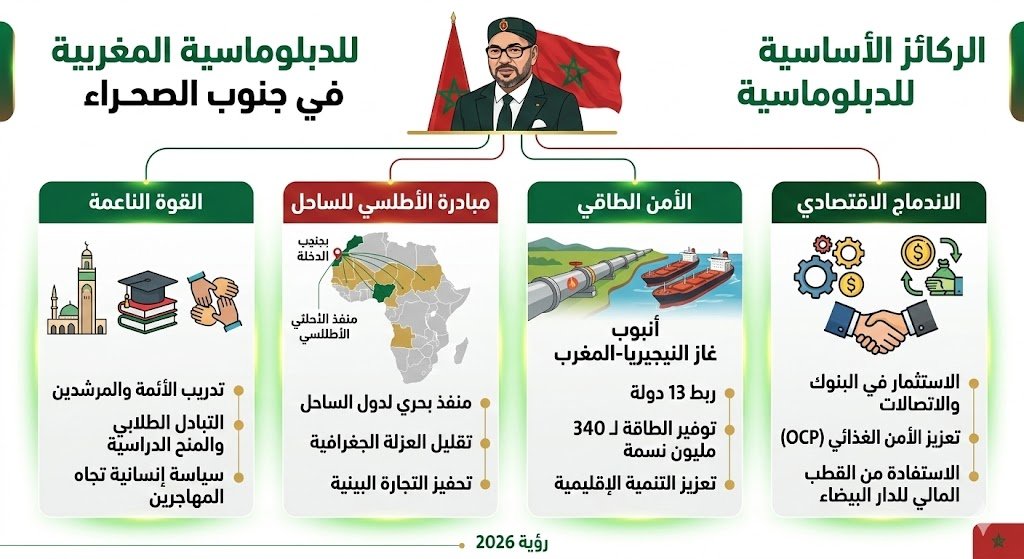
But why are these relations so critical today? Beyond the shared history and geography, the alliance between Rabat and Sub-Saharan capitals is built on four fundamental pillars: Economic Sovereignty, Energy Security, Regional Stability, and Cultural Leadership.
1. Economic Integration: Moving Beyond Trade
Morocco has established itself as a leading investor in Sub-Saharan Africa, particularly in the banking, telecommunications, and insurance sectors. By 2026, the Kingdom’s presence is visible in over 30 African nations.
- Casablanca Finance City (CFC): Acting as a premier financial hub, CFC facilitates the flow of international capital into African markets, positioning Morocco as the “bridge” between the Global North and South.
- The Investment Charter: Morocco’s internal reforms have created a template for “Co-development,” where Moroccan expertise in phosphate processing (OCP Group) helps African farmers achieve food security through tailored soil fertilizers.
2. The Atlantic Initiative: A Lifeline for the Sahel
One of the most ambitious diplomatic moves in recent years is the Atlantic Initiative. Launched to provide landlocked Sahelian countries—such as Mali, Niger, Burkina Faso, and Chad—with access to the Atlantic Ocean, this project is a game-changer for regional trade.
The Dakhla Atlantic Port serves as the crown jewel of this vision. By offering state-of-the-art logistics and maritime access, Morocco is effectively reducing the “structural penalty” of being landlocked, fostering a new era of prosperity for the Sahel.
3. Energy Security: The Nigeria-Morocco Gas Pipeline
As Europe and Africa both seek diversified energy sources, the Nigeria-Morocco Gas Pipeline (NMGP) stands as the continent’s most significant infrastructure project.
- Regional Impact: Spanning over 5,600 kilometers and crossing 13 countries, the pipeline is set to bring electricity to over 340 million people.
- Diplomatic Leverage: By spearheading this project, Morocco is anchoring West African nations into a shared economic destiny, ensuring that energy wealth benefits the entire Atlantic coast of Africa.
4. Soft Power: Religion, Education, and Migration
Morocco’s influence isn’t just measured in dirhams or gas cubic meters; it’s rooted in “Soft Power.”
- Religious Diplomacy: The Mohammed VI Institute for the Training of Imams hosts hundreds of students from across Africa, promoting a moderate, “Middle Way” Islam that counters extremist ideologies in the Sahel.
- Migration Leadership: Morocco has moved from being a transit country to a host country. By regularizing the status of tens of thousands of Sub-Saharan migrants, Rabat has earned significant “diplomatic goodwill” and set a humanitarian standard for the continent.
SEO Insights: The 2026 Outlook
As we look toward the remainder of 2026, Morocco’s role in the African Union (AU) continues to grow. The Kingdom’s return to the AU in 2017 was the catalyst, but its current leadership in peace and security committees proves that Morocco is the indispensable partner for any global power wishing to engage with Africa.
“Africa must trust Africa,” a famous quote by King Mohammed VI, remains the guiding principle. This trust is now yielding tangible results in the form of stable borders, growing markets, and a unified voice on the global stage.
