
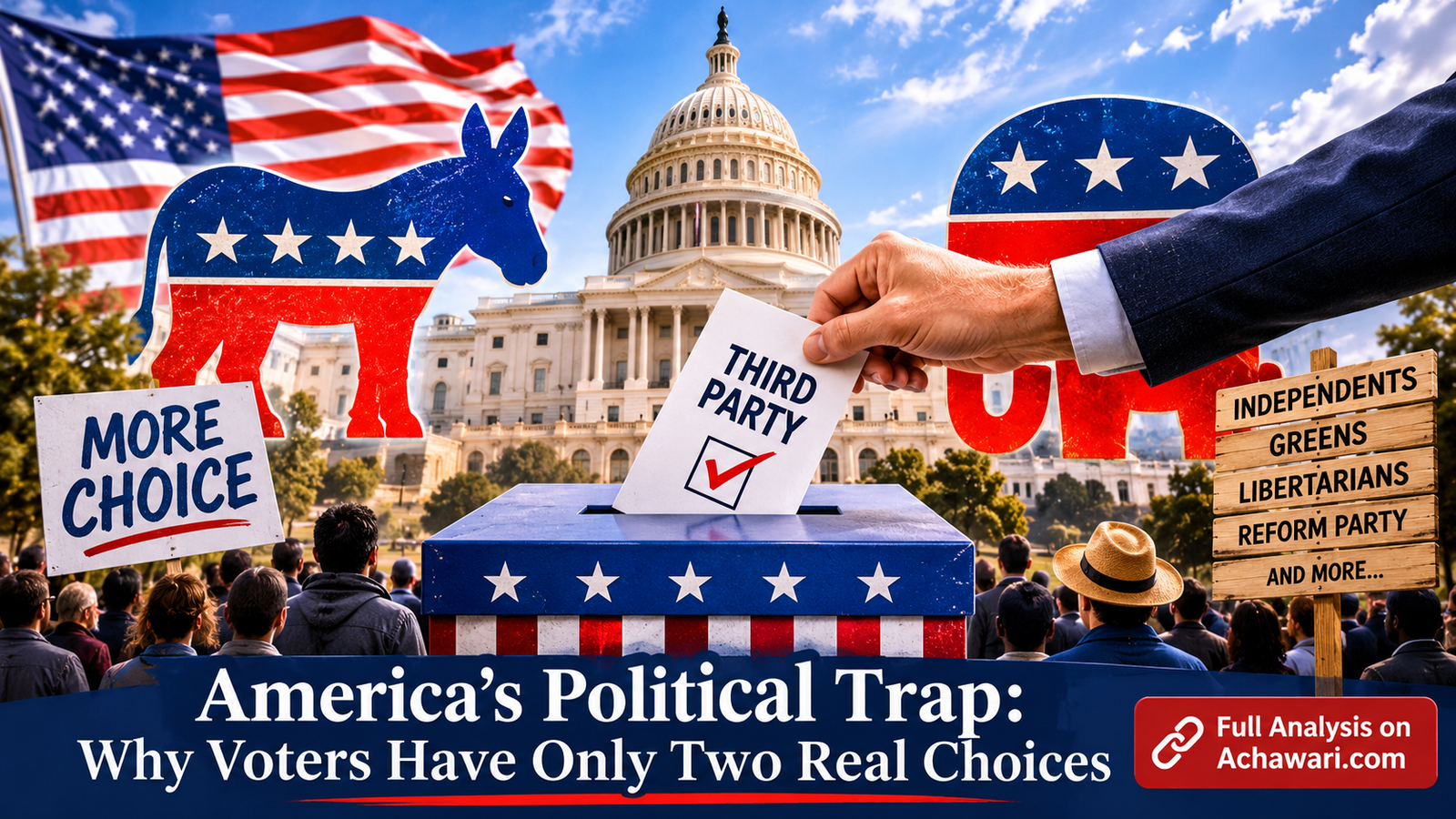
America’s Political Trap: Why Voters Have Only Two Real Choices

Achawari.com
For generations, American democracy has presented itself as a model of political freedom, competition, and popular sovereignty. Yet beneath the familiar language of democratic choice lies a persistent contradiction: millions of Americans can vote, campaign, organize, criticize their government, and express dissatisfaction with their political representatives, but when election day arrives, they are overwhelmingly expected to choose between two political machines.
The Democratic Party and the Republican Party have dominated the American political landscape for more than a century. Their candidates occupy the White House, control Congress, shape state governments, and determine much of the national political conversation. Smaller parties and independent candidates occasionally attract attention, sometimes even millions of votes, but rarely translate that support into lasting political representation.
This raises a fundamental question: Are Americans destined to remain trapped in a political system dominated by two parties, or can they establish a genuinely competitive multiparty democracy?
The answer is not predetermined. The United States does not legally limit political competition to two parties. However, its electoral institutions, campaign-financing environment, political traditions, and established party structures create powerful incentives that preserve the existing arrangement.
Changing this reality requires more than creating another political organization. It requires changing the rules that determine who can compete, how votes are translated into seats, and whether voters can support alternatives without feeling that they are wasting their ballots.
Why Does America Have Only Two Dominant Political Parties?
The American two-party system is not explicitly prescribed by the Constitution. The founding document does not require the existence of Democrats and Republicans, nor does it prevent citizens from establishing alternative political organizations.
The system developed historically through political competition, institutional arrangements, and electoral incentives.
One of its most important characteristics is the use of single-member electoral districts for elections to the House of Representatives. In most elections, the candidate who receives the largest number of votes wins the seat, even without obtaining an absolute majority.
This arrangement creates a difficult environment for smaller parties.
Imagine a district where a Republican receives 42 percent of the vote, a Democrat receives 40 percent, and an independent candidate receives 18 percent. The Republican wins the seat, while the independent’s substantial support produces no direct representation.
Voters who might prefer an independent candidate often hesitate to support one because they fear helping elect the major-party candidate they oppose most strongly.
This is commonly described as the spoiler effect.
Political scientists have long studied how winner-take-all electoral systems encourage the concentration of political competition around two major parties. The phenomenon is often associated with Duverger’s Law, which explains the tendency of plurality electoral systems to favor two-party competition.
The result is a self-reinforcing cycle: voters choose between the two established parties because smaller candidates appear unlikely to win, and smaller candidates remain weak because voters continue choosing the established parties.
The presidency reinforces this structure. The Electoral College, combined with the winner-take-all allocation of electoral votes in most states, makes it particularly difficult for a third-party presidential candidate to compete nationally.
Consequently, a political movement may attract considerable public support without acquiring the institutional power necessary to challenge the two dominant parties.
The Independent Voter Paradox
One of the most interesting features of contemporary American politics is the growing number of citizens who identify themselves as independents.
Many Americans are dissatisfied with both major parties. Some reject the ideological positions of the Democrats, while others oppose the Republican leadership or disagree with its economic and social priorities. Still others feel that neither party adequately represents their concerns.
A November 2026 Al Jazeera analysis highlighted the contradiction between the large number of Americans identifying as politically independent and the limited electoral success of independent candidates. It also examined the financial and institutional difficulties facing smaller political organizations.
Yet identifying as an independent does not necessarily mean voting for an independent candidate.
Many voters who reject party labels continue to support Democratic or Republican candidates because they believe those candidates have a realistic chance of winning. Their decisions are often strategic rather than enthusiastic.
This is one of the central weaknesses of the existing system: political dissatisfaction does not automatically produce political alternatives.
A voter may dislike both parties but still consider one of them preferable to the other. Over successive elections, this logic can turn political choice into a defensive exercise rather than an opportunity to support a positive political programme.
The question, therefore, is not simply how to persuade Americans to support a third party. It is how to create electoral conditions in which supporting a third party becomes a meaningful and realistic democratic choice.
What Prevents New Political Parties from Becoming Competitive?
The obstacles facing third parties are institutional, financial, organizational, and cultural.
1. Restrictive ballot-access requirements
Political parties and independent candidates must satisfy different state-level requirements to appear on election ballots.
Depending on the state and the election, these requirements may involve collecting signatures, meeting registration thresholds, paying fees, or demonstrating a minimum level of previous electoral support.
The rules vary considerably across the country. This creates a complicated and expensive process for organizations attempting to build a national presence.
Democratic and Republican candidates benefit from established recognition and electoral infrastructure, while newcomers must spend considerable resources simply securing access to the ballot.
2. The financial advantage of established parties
Modern American elections require enormous financial resources.
Major parties benefit from established fundraising networks, wealthy donors, political action committees, experienced campaign organizations, and extensive media exposure.
New parties generally lack these advantages.
Even when an alternative movement attracts considerable public interest, transforming that interest into a sustainable electoral organization requires offices, staff, legal assistance, candidates, communications networks, and long-term funding.
Without financial resources, a new party may struggle to compete beyond a handful of local elections.
3. Media visibility and political recognition
The American political media environment is heavily organized around competition between Democrats and Republicans.
Television debates, political interviews, campaign coverage, and election analysis frequently concentrate on the two established parties.
Third-party candidates may receive attention when their campaigns become controversial or unexpectedly influential, but sustained coverage is much harder to obtain.
This creates another cycle: candidates receive limited coverage because they are considered unlikely to win, and they remain unlikely to win partly because they receive limited coverage.
4. The fear of wasting a vote
Perhaps the most powerful obstacle is psychological.
Voters often believe that supporting a candidate outside the two major parties will have no practical effect, or worse, will help the major candidate they dislike most.
This fear discourages electoral experimentation and makes it difficult for alternative parties to establish a reliable constituency.
The problem cannot be solved through political advertising alone. It requires changes to the electoral system itself.
What Would It Take to Establish a Genuine Multiparty System?
A more competitive political environment is possible, but it requires structural reforms rather than simply adding new names to the ballot.
Several reforms deserve serious consideration.
1. Introduce Proportional Representation
Proportional representation is among the most significant possible reforms.
Under a proportional electoral system, political parties receive legislative seats in relation to the percentage of votes they obtain, subject to the rules and thresholds of the particular system.
For example, a party receiving 15 percent of the vote could obtain a meaningful share of legislative representation instead of winning nothing because its supporters are geographically dispersed.
This would change the incentives facing voters and political organizations.
Smaller parties could develop national programmes, build constituencies, and compete for legislative influence without necessarily having to defeat Democrats or Republicans in every individual district.
One possible approach would be multi-member congressional districts, where several representatives are elected from a larger geographical area.
The FairVote report published in September 2026 argues that proportional representation in multi-member districts could provide a practical foundation for a more pluralistic American political system.
It also recognizes that the presidency and the Senate would remain institutional challenges because their electoral structures differ from those of the House of Representatives.
2. Expand Ranked-Choice Voting
Ranked-choice voting offers another possible route.
Instead of selecting only one candidate, voters rank candidates in order of preference.
If no candidate receives the required majority of first-choice votes, the candidate with the fewest votes is eliminated, and those ballots are redistributed according to voters’ next preferences. The process continues until a candidate reaches the required threshold.
Supporters argue that this system reduces the spoiler problem and encourages candidates to appeal beyond their traditional political bases.
It can make voters more comfortable supporting independent or third-party candidates because they can express their first preference while retaining a second choice.
However, ranked-choice voting is not a complete solution by itself. It does not automatically create proportional representation in Congress, nor does it guarantee that new parties will acquire legislative seats.
According to a Congressional Research Service analysis published in October 2026, ranked-choice voting has been adopted in nearly 50 American jurisdictions, although its use remains politically and legally contested in several states.
3. Make Ballot Access Fairer
A democratic political system should not make entry into electoral competition unnecessarily difficult.
States could establish more consistent and reasonable ballot-access requirements, including transparent signature thresholds, affordable registration procedures, and equal treatment of emerging political organizations.
New parties should demonstrate genuine public support, but the requirements should not be so demanding that only organizations with established financial networks can compete.
The objective should be to distinguish legitimate political participation from electoral manipulation without protecting established parties from competition.
4. Reform Campaign Financing
A new political party cannot compete effectively if the financial playing field is overwhelmingly dominated by established organizations and wealthy donors.
Public campaign financing, small-donor matching systems, greater transparency, and reasonable spending regulations could help broaden political participation.
Such reforms would not eliminate financial inequalities, but they could reduce the dependence of political competition on wealthy fundraising networks.
The aim should be to make political representation more accessible to citizens who have ideas, programmes, and public support but lack access to powerful financial networks.
5. Open Up Primary Elections
Primary elections determine who represents the major parties in general elections.
In some states, participation is restricted according to party registration rules, meaning independent voters may have limited influence over the selection of candidates.
Open or nonpartisan primaries could allow a wider section of the electorate to participate.
Some proposed systems would allow the leading candidates, regardless of party affiliation, to advance to the general election.
The American Bar Association’s 2025 Task Force for American Democracy identified open nonpartisan primaries, ranked-choice voting, and fusion voting as possible reforms that states should consider.
These approaches would not necessarily create new parties, but they could weaken the control of established party organizations over electoral competition.
Could Fusion Voting Help Break the Two-Party Monopoly?
One reform that receives less attention than proportional representation is fusion voting.
Under fusion voting, two or more political parties can nominate the same candidate, with that candidate’s consent. The candidate appears on the ballot under different party labels, and the votes received under those labels are combined.
This arrangement allows smaller parties to support candidates who have a realistic chance of winning without abandoning their political identities.
For example, a progressive party could endorse a Democratic candidate while retaining its own name, organization, and political programme. Its supporters could express their preference for that party while contributing to the candidate’s overall vote.
Fusion voting can therefore reduce the spoiler problem and give smaller political organizations a way to influence public policy.
The practice has historical roots in American politics, but its availability is now limited. The American Bar Association’s 2025 report notes that New York and Connecticut are the two states permitting full fusion voting.
Expanding this approach could provide an intermediate step toward a more pluralistic political environment.
Would More Political Parties Make American Democracy Better?
The establishment of additional parties would not automatically solve America’s political problems.
Multiparty systems can produce fragmented legislatures, unstable coalitions, prolonged negotiations, and governments that struggle to implement coherent policies.
The existence of five or six parties does not necessarily guarantee better representation or more effective government.
However, political pluralism can offer an important democratic advantage: it allows different social, economic, regional, and ideological interests to find independent political expression.
A voter who supports environmental protection but rejects the economic policies of the Democratic Party, for example, should have a meaningful political alternative.
Likewise, a conservative voter who disagrees with the Republican leadership should not be forced to choose between accepting the party’s entire programme and abandoning their political preferences.
More competition could also encourage established parties to reconsider their policies, listen more carefully to their constituencies, and become more responsive to citizens.
The objective should not be to create political fragmentation for its own sake. It should be to ensure that the political system reflects the diversity of the electorate.
Can the United States Actually Escape the Two-Party System?
The most realistic answer is that the United States could gradually move toward a more competitive political system, but a complete transformation would be difficult.
The presidency, the Senate, the Electoral College, established fundraising networks, and deeply rooted party loyalties all reinforce the existing structure.
Changing some aspects of congressional elections could be achieved through legislation and state-level reforms. Other changes, particularly those affecting presidential elections, could require much more complicated constitutional and political negotiations.
There is also a question of political will.
The Democratic and Republican parties have different ideological programmes, but both benefit institutionally from a system that concentrates political competition around themselves.
Consequently, meaningful reform may have to emerge from citizens, independent organizations, state-level initiatives, civic movements, and political coalitions that recognize a shared interest in expanding electoral choice.
The transformation need not begin with a new national party announcing its arrival in Washington.
It could begin in municipal elections, state legislatures, and congressional districts where alternative candidates gradually demonstrate that they can win public support.
A successful movement would need more than a charismatic leader or a temporary wave of public anger. It would require a durable organization, credible candidates, a clear political programme, local networks, transparent financing, and the ability to survive beyond a single election cycle.
The American political system is not condemned by history to remain permanently divided between two parties. But neither will it become multiparty simply because millions of voters are dissatisfied.
The decisive question is whether Americans are prepared to demand changes to the rules that govern political competition.
A democracy should offer citizens more than the opportunity to choose between two established political organizations. It should also give them a realistic opportunity to create alternatives, organize around new ideas, and translate public support into political representation.
The future of American democracy may therefore depend less on which of the two major parties wins the next election than on whether American voters can eventually change the political rules of the game itself.
